

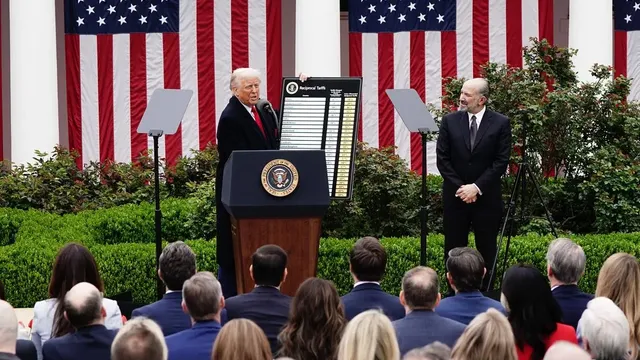
Supreme Court strikes down Trump's tariff plans, raising global trade uncertainty
Supreme Court strikes down Trump's tariff plans, raising global trade uncertainty
- The US Supreme Court ruled against Trump's tariffs on February 20, 2026.
- The decision has generated renewed uncertainty in global trade and could impact countries with existing deals with the US.
- Analysts warn that Trump's administration may quickly seek alternative means to impose tariffs, maintaining high volatility.
Story
On February 20, 2026, the US Supreme Court ruled against President Donald Trump's use of tariffs that were based on the International Emergency Economic Powers Act. This decision is viewed as a setback for Trump's strategy to use tariffs as a tool for economic leverage. The ruling is expected to create ongoing uncertainty in the global economy as analysts believe Trump will seek alternative methods to impose tariffs in the future. While the average US tariff dropped significantly, it remains that businesses now face a renewed period of confusion regarding trade and pricing strategies. Experts noted that this decision dramatically affects countries with previously high tariff levels, including China, Brazil, and India, which will see notable reductions in tariff rates. However, countries that had negotiated bilateral agreements with the US are now questioning whether they hold any leverage to renegotiate their deals given the recent ruling. Sean Marks, analyst at the European Policy Centre think tank, remarked on the potential for further confusion as new tariffs may soon be announced, thus perpetuating a cycle of uncertainty. The political landscape surrounding US tariffs continues to evolve as the administration faces a mixed economic response. China's trade surplus is reported to have reached nearly $1.2 trillion due to successful adaptation to the tariff conditions, shifting focus toward non-US markets. Meanwhile, businesses were beginning to establish a functional equilibrium with higher tariffs, making the Supreme Court decision even more disruptive to established pricing and inventory strategies. Christine Lagarde, the president of the European Central Bank, emphasized the need for clarity in trade regulations to ensure stability. In summary, the recent Supreme Court ruling serves to not only highlight the volatility of Trump’s trade policies but also signals that despite the reduction in tariffs, the implications of ongoing uncertainty could weaken global trade dynamics. The situation calls into question future tariff policy directions and how countries may respond to renegotiate existing agreements in light of this new legal framework.


