

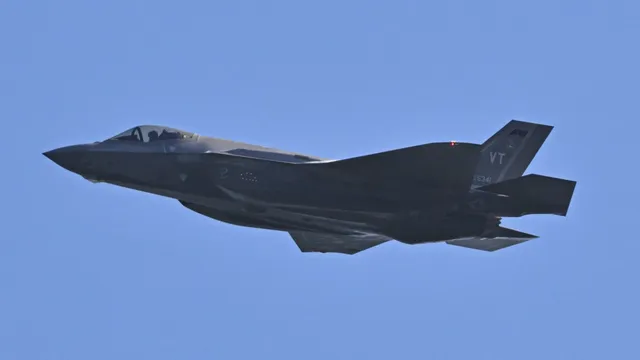
U.S. F-35 hit by Iranian fire and makes emergency landing
U.S. F-35 hit by Iranian fire and makes emergency landing
- A U.S. F-35 aircraft made an emergency landing at a U.S. airbase following reported strikes by Iranian fire.
- The incident marks the first time during the current conflict that Iranian forces have targeted an American aircraft.
- Authorities have confirmed that the pilot is in stable condition, while the incident is currently under investigation.
Story
In the context of ongoing conflict in the Middle East, a U.S. F-35 fighter jet was forced to make an emergency landing at a regional U.S. airbase. This incident occurred while the aircraft was on a combat mission over Iran and was reportedly struck by Iranian fire, marking the first time Iranian forces have targeted an American aircraft since the war began late last month. Captain Tim Hawkins from U.S. Central Command confirmed that the aircraft landed safely and that the pilot is in stable condition. The specifics of how the Iranian fire impacted the jet remain under investigation. The event follows a series of escalations between U.S. and Iranian forces since the onset of the recent conflict, which began on February 28. The situation has drawn attention to the capabilities of both sides, particularly the limitations claimed by U.S. officials about Iran’s air defense systems. Despite Iranian assertions of their military capabilities, U.S. secretaries have stated Iran lacks a robust military presence in the air and naval domains. This incident could prompt further scrutiny of air operations and strategies in the region. The emergency landing comes just one week after a tragic incident involving a U.S. refueling tanker, which crashed in friendly airspace over Iraq, resulting in the deaths of all six crew members. Eyewitness reports suggest that a midair collision may have been responsible for that crash. Military operations in the region continue to be hazardous, with various entities conducting missions regularly. This latest development may raise questions about the effectiveness of U.S. claims regarding Iranian military weakness and suggest potential shifts in tactical approaches. In a public statement, President Donald Trump remarked on the conflict, insisting that Americans were safe despite incidents occurring, even as the military continues to assert its operational successes. This contrast between official narratives and emerging ground reports will likely fuel discussions about the actual realities faced by U.S. personnel in combat zones. The Pentagon is expected to release further information as investigations into both the emergency landing and the earlier tanker crash progress.
Context
The history of the U.S.-Iran conflict is complex and deeply rooted in political, ideological, and cultural differences that date back to the early 20th century. The tension began to escalate in the mid-20th century when the U.S. supported the overthrow of Iran's democratically elected Prime Minister Mohammad Mossadegh in 1953, reinstating the Shah, Mohammad Reza Pahlavi. This act, motivated by the desire to maintain Western control over Iranian oil resources and counter Soviet influence, led to widespread resentment among the Iranian populace. The Shah's authoritarian regime, characterized by political repression and Westernization efforts that clashed with traditional Islamic values, further exacerbated the discontent among the Iranian people, laying the groundwork for future conflict. The situation intensified with the Iranian Revolution of 1979, which resulted in the Shah's exile and the establishment of the Islamic Republic under Ayatollah Khomeini. This revolution was a reaction not only against Western imperialism but also against the secular policies of the Shah’s government. Following the revolution, the U.S. severed diplomatic ties with Iran, and tensions peaked when Iranian students seized the U.S. embassy in Tehran, taking 52 American hostages for 444 days. This crisis not only fueled anti-American sentiment in Iran but also led to a series of retaliatory actions by the U.S., including economic sanctions and attempts to isolate Iran internationally. In the decades that followed, the U.S.-Iran relations remained fraught with tension. The Iran-Iraq War (1980-1988) saw a proxy conflict where the U.S. supported Iraq while Iran faced increasing isolation. The late 1980s and 1990s were marked by further hostile encounters, including accusations of Iran sponsoring terrorism and the U.S. targeting Iranian interests in the region. The most significant development came in the 2000s with concerns over Iran's nuclear program, leading to a further deterioration of relations. The U.S. imposed stringent sanctions on Iran, aiming to curb its nuclear ambitions, which were perceived as a threat to both regional and global security. The culmination of these tensions was reflected in the U.S. withdrawal from the Joint Comprehensive Plan of Action (JCPOA) in 2018 under the Trump administration, which had originally been designed to limit Iran's nuclear capabilities in exchange for sanctions relief. This withdrawal reignited historical hostilities, leading to increased sanctions and military confrontations in the Persian Gulf. The subsequent assassination of Iranian General Qasem Soleimani in early 2020 marked a significant escalation, prompting further retaliatory actions from Iran. The conflict continues to evolve as both nations navigate their interests and regional dynamics, leaving a legacy of distrust that shapes the geopolitical landscape in the Middle East today.


