

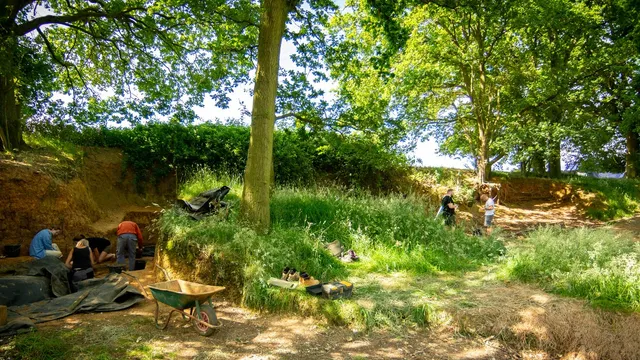
Archaeologists reveal fire-making dates back 350,000 years earlier than thought
Archaeologists reveal fire-making dates back 350,000 years earlier than thought
- Archaeologists uncovered evidence of a campfire and heated sediments at a 400,000-year-old site in Barnham, Suffolk.
- This finding significantly pushes back the timeline for the earliest known use of fire by nearly 350,000 years from previously accepted evidence.
- The discovery emphasizes the crucial role of fire in early human survival, nutrition, and social communication.
Story
In a groundbreaking discovery in the UK, archaeologists uncovered evidence of controlled fire-making dating back over 400,000 years at a site in Barnham, Suffolk. This remarkable finding challenges the previously held belief that the earliest evidence of fire use by prehistoric humans was only 50,000 years old, with records showing activity in France. The excavation revealed remnants of a campfire, as well as fire-cracked flint and heated sediments, indicating repeated use of fire at this location. Two fragments of iron pyrite, known for creating sparks when struck, were also found, suggesting that the individuals at the site intentionally brought the mineral to start fires. This discovery took four years of meticulous research to validate that the heating of the clay was not a result of natural causes such as wildfires, but rather of human activity. Geological evidence indicates that the pyrite discovered is locally rare, further pointing to the likelihood of its deliberate transportation for fire production purposes. The hearth discovered measures about half a meter in diameter and is interpreted to have functioned similarly to a small campfire. Researchers, including Professor Chris Stringer from the Natural History Museum, hypothesize that these fires were created by early Neanderthals, although the specific occupants of the site are not definitively known. At the time, brain sizes among early humans were expanding, and the ability to control fire would have significantly aided in survival and nutrition, helping to sustain their growing brains. The use of fire allowed for cooking, which broadened the range of edible foods and fostered environments conducive to social interactions and communal living. Notably, it is suggested that this capability may have even contributed to the evolution of language. The implications of this discovery are profound, highlighting how the ability to make and use fire was crucial in human development and social structure, with Professor Nick Ashton, curator at the British Museum, calling it one of the most exciting findings of his 40-year career. The research findings are documented in a paper titled 'Earliest Evidence of Making Fire,' published in the journal Nature.
Context
policy shift analysis shift strategic geopolitical economic trends trends economic strategic insight data policy strategic data geopolitical strategic impact analysis analysis data global impact analysis data insight data geopolitical strategic economic trends impact policy shift global impact geopolitical analysis trends market impact impact insight impact market data geopolitical policy geopolitical impact global shift policy economic insight policy policy policy global data policy economic economic geopolitical shift insight geopolitical geopolitical economic geopolitical analysis geopolitical insight shift data strategic strategic impact impact...


