

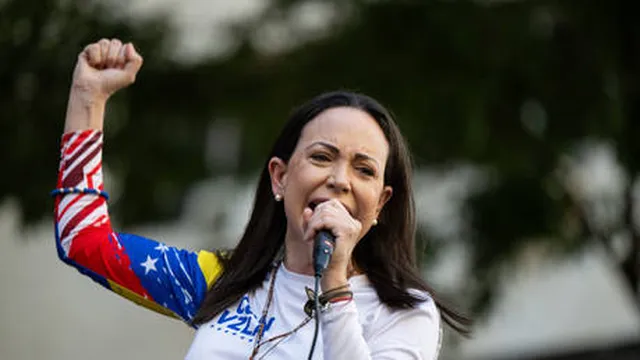
Trump rejects Venezuela's Nobel laureate as leader
Trump rejects Venezuela's Nobel laureate as leader
- U.S. forces conducted operations in Venezuela, capturing Nicolás Maduro on January 3, 2026.
- Donald Trump expressed skepticism regarding Maria Corina Machado's capacity to lead Venezuela due to a lack of support.
- Trump indicated that Delcy Rodriguez is positioned as Maduro's replacement, proposing cooperation to restore the country.
Story
Venezuela, a country experiencing political turmoil, has seen heightened tensions following the recent removal of President Nicolás Maduro. On January 3, 2026, U.S. forces conducted air strikes in Caracas, capturing Maduro and mandating a transition of power. Following this incident, President Donald Trump commented on the situation, expressing doubts about Maria Corina Machado, the opposition leader and Nobel Peace Prize winner, being able to lead the nation. Trump characterized her as a 'very nice woman' but conveyed that she lacked the necessary support and respect among the Venezuelan populace. Maria Corina Machado had previously gained prominence as the head of the Vente Venezuela party, winning a presidential primary in 2023 but was subsequently barred from running for office due to accusations from the Supreme Tribunal of Justice which questioned her eligibility. Despite her efforts to combat the Maduro regime and her relations with U.S. officials, Trump indicated that the U.S. government had not communicated with her during the military operations undertaken against Venezuela. In contrast, Trump suggested that Venezuelan Vice President Delcy Rodriguez was poised to assume power, stating that she appeared willing to cooperate with the U.S. for the promotion of democracy in the nation. The backdrop to this unfolding drama includes Machado's consistent calls for a return to democratic governance in Venezuela. Her advocacy for U.S. intervention while clarifying that this does not equate to 'regime change' reflects her controversial stance. After winning the Nobel Peace Prize in 2025 for her contributions toward seeking a democratic outcome for Venezuela, Machado commanded respect on the international stage. However, despite this international recognition, her domestic support remains questionable according to Trump, who stated that genuine leadership requires public endorsement. The ramifications of Trump's dismissal of Machado raise concerns about the future leadership and political direction of Venezuela. The coming weeks will likely be critical in determining who will emerge as the legitimate leader and how the U.S. will influence this process. The political landscape in Venezuela remains unstable, and the international community is keeping a close watch on events as they develop.
Context
The Nobel Peace Prize, established in 1895 by the will of Alfred Nobel, is awarded annually to individuals or organizations that have made significant contributions to peace efforts. The recognition conferred by the prize has a profound impact on political leaders worldwide. It not only brings international attention to the laureates but also catalyzes movements and initiatives aimed at conflict resolution, social change, and humanitarian efforts. Political leaders receiving this prestigious award often experience heightened visibility significant public support, which can influence their domestic and international policies. The prize serves as a double-edged sword; while it can enhance a leader's legitimacy and bolster their initiatives for peace, it may also provoke skepticism, backlash, and polarized responses from opposing factions within their own countries or abroad. Moreover, the Nobel Peace Prize can redefine the trajectories of political leaders, as seen in the cases of former U.S. President Barack Obama and South African President Nelson Mandela. Both leaders leveraged the recognition of their commitment to peace and reconciliatory politics to promote their agendas domestically and internationally. Obama's Nobel recognition in 2009, for instance, was both an acknowledgment of his aspirations for global peace and a platform that magnified his initiatives in areas such as nuclear disarmament and climate change. On the other hand, Mandela's receipt of the prize in 1993 not only symbolized his pivotal role in dismantling apartheid but also encouraged civil rights movements across the globe, showcasing the interconnectedness of peace initiatives. Political leaders often harness the Nobel Peace Prize to rally support, enhancing their capacity to enact policy changes or solidify coalitions. In many cases, the award inspires leaders to prioritize peace talks and collaborative efforts, as its moral authority can mitigate oppositional stances during negotiations. However, laureates face the complex task of translating the ideals embodied by the award into practical and sometimes contentious real-world actions. The pressure to fulfill the expectations that accompany the Prize can provoke criticism, particularly if the leader’s subsequent actions diverge from the anticipated ideals of peace and reconciliation. Consequently, receiving the prize can add a layer of complexity to a leader's existing political landscape. In summary, the Nobel Peace Prize influences political leaders by elevating their platform, enhancing their moral authority, and providing opportunities for advancing peace initiatives. The award is not only a symbol of recognition but also a tool that can be wielded to garner support for broader agendas. While the bestowed honor can significantly affect international relations and guide domestic policy, its impact is nuanced and varies depending on the leader’s approach to the responsibilities and expectations that come with the accolade. Ultimately, the legacy of the Nobel Peace Prize resonates far beyond the individual laureates, shaping intersections between peace efforts and political landscapes around the world.


