

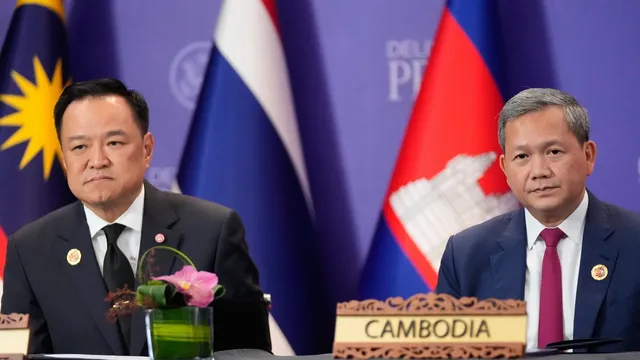
Thailand launches airstrikes as tensions escalate with Cambodia
Thailand launches airstrikes as tensions escalate with Cambodia
- Thailand conducted airstrikes after Cambodian troops allegedly fired first.
- Thai casualties were reported, with one soldier killed and four wounded.
- The situation indicates ongoing tensions that threaten regional stability.
Story
On the disputed border between Thailand and Cambodia, hostilities flared recently as Thailand executed airstrikes in response to alleged initial attacks by Cambodian troops. The confrontations reignited tensions that have simmered since a ceasefire agreement was brokered by U.S. President Donald Trump in October 2020, following a brief conflict that resulted in significant casualties. Thai army spokesperson Major General Winthai Suvaree reported that Cambodian forces initiated fire into Thai territory, leading to one Thai soldier's death and injuries to four others, along with the evacuation of civilians from the affected regions. In a counter-response, Cambodia's Defense Ministry spokesperson Maly Socheata claimed that Thai military action was the first provocation, alleging that no Cambodian retaliation occurred at the time of Thailand's attacks. As both nations continue to accuse each other of hostility, the situation remains highly volatile, straining relations further and threatening regional stability. The U.S.-mediated ceasefire appeared to be in jeopardy last month when Thai troops were injured by land mines, further complicating the fragile peace that had been established. Despite efforts towards cooperation in eliminating land mines, conflicting narratives have developed, complicating diplomatic efforts. This incident marks another serious escalation between the two countries which, despite having previously agreed to a truce, have not fully resolved their ongoing territorial disputes or ended their mutual accusations. The situation underscores the necessity of sustained international mediation to maintain peace and stability in this part of Southeast Asia. The re-emergence of this conflict echoes the consequences of prior engagements, where five days of combat led to numerous casualties and deep-seated grievances. Long-standing historical tensions between the two countries continue to challenge diplomatic resolutions, as both sides remain firm in their stances regarding territorial claims and military engagements. These developments illustrate how difficult it can be to sustain peace in a region marked by contested borders and the legacies of historical conflicts.
Context
The historical context of the Thailand-Cambodia border disputes is deeply rooted in a complex web of historical events, treaties, and national identities. The tensions can be traced back to pre-colonial times when both nations shared cultural and political ties, influenced by the Khmer Empire. However, the modern disputes largely arose during the colonial era, particularly when Southeast Asia was divided among European powers. The borders were not clearly demarcated, leading to ambiguities that would later fuel disagreements. Notably, the Franco-Siamese treaties of the early 20th century established many of the current borders, yet they left several areas, particularly around ancient temples, contested due to differing interpretations of the agreements. One of the most significant sources of contention is the area around the Preah Vihear Temple, which both nations claim as part of their territorial rights. This temple has not only historical and cultural significance but also strategic importance due to its location. In 1962, the International Court of Justice (ICJ) ruled that the temple was in Cambodian territory, a decision that Thailand initially contested but later accepted. However, this ruling did not resolve underlying tensions, and sporadic conflicts continued, especially when border enforcement agents or military personnel confronted one another. The disputes led to violent skirmishes, particularly in the late 2000s, which affected both nations' diplomatic relations and local populations near the border. Beyond territorial rights, national pride plays a crucial role in the enduring rivalry between Thailand and Cambodia. Both countries emphasize their historical narratives, often portraying themselves as victims of imperialism and defending their heritage against perceived aggression from the other. Nationalism has been a driving force in both nations’ politics, fueling public sentiment during border disputes and exacerbating tensions. Moreover, domestic political challenges in either country can lead to leaders using these disputes as a rallying point to strengthen their political positions, sometimes at the expense of diplomatic resolutions. In recent years, measures have been taken to stabilize relations, such as the establishment of joint border committees and initiatives to promote tourism to shared cultural heritage sites. However, the path to lasting peace is complicated by deep-seated historical grievances and the need for both nations to navigate domestic pressures while engaging in constructive dialogue. As both countries continue to grapple with their past, the quest for a definitive and peaceful resolution remains a challenging endeavor, emphasizing the necessity for thoughtful diplomacy and mutual understanding.


