
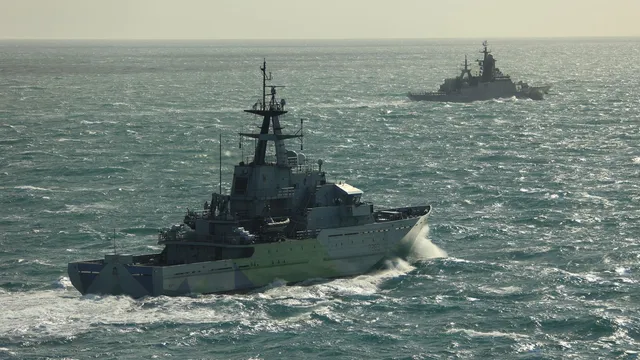
Royal Navy tracks Russian warship and sanctioned oil tanker in the English Channel
- HMS Mersey and a Wildcat helicopter monitored a Russian warship and sanctioned oil tanker for 48 hours.
- The operation was coordinated with NATO to ensure maritime security in the English Channel.
- This highlights the Royal Navy's ongoing commitment to monitor Russian activity in UK waters.
Story
In the English Channel, a Russian warship and a sanctioned oil tanker were closely monitored by a Royal Navy warship and helicopter. This operation involved HMS Mersey and a Wildcat helicopter, which were deployed for a period of 48 hours to track the movements of the Russian Steregushchiy-class frigate RFN Soobrazitelny and the oil tanker MV Anatoly Kolodkin. The Royal Navy’s actions were taken in coordination with NATO, highlighting their effort to safeguard UK waters. The two Russian vessels ultimately separated, with the frigate tracked back eastward while the oil tanker continued into the Atlantic. This marks a continuation of heightened vigilance by the UK military in the face of Russian naval activities in the region. Just two weeks prior, the Royal Navy had shadowed two sanctioned Russian cargo ships as they navigated from the Mediterranean Sea to the North Sea, indicating a systematic approach to monitoring Russian marine operations, which may pose a future threat to UK maritime security. Lieutenant Commander Dan Wardle, the commanding officer of HMS Mersey, affirmed the operation's significance, illustrating the Royal Navy’s commitment to safeguarding the integrity of British maritime interests, further enhancing situational awareness and response capabilities. Fleet commander Vice Admiral Steve Moorhouse expressed that the Royal Navy remains steadfast in its duty to protect UK home waters amidst increasing global tensions and uncertainties regarding maritime activities. The continuing interception of Russian vessels serves as a stark reminder of the naval competition and the need for allied forces to maintain a vigilant stance in the face of potential threats to maritime security.
Context
The North Atlantic Treaty Organization (NATO) plays a crucial role in maritime security operations, reflecting its commitment to collective defense and stability in the maritime domain. Established in 1949, NATO has evolved to address various security challenges, including those that arise from the maritime environment. Maritime security encompasses a range of activities such as the protection of vital sea lanes, combating piracy, ensuring the integrity of maritime borders, and responding to humanitarian crises. The alliance's operational framework fosters collaboration among member states, leveraging their combined capabilities to enhance maritime safety and security across the North Atlantic region and beyond. NATO's maritime security operations are primarily executed through its Maritime Command, which coordinates naval forces from member countries to conduct a variety of missions. These missions often include operations aimed at countering piracy, deterring illegal trafficking in arms and drugs, and enforcing embargoes. The Operation Ocean Shield, launched in 2009 to combat piracy off the coast of Somalia, is one significant example of NATO's proactive engagement in maritime security. This operation not only involved naval patrols but also integrated air surveillance and support for training local maritime forces, demonstrating NATO's multifaceted approach to maritime security challenges. Furthermore, NATO is actively involved in international partnerships that augment its maritime security capabilities. Cooperation with organizations such as the European Union and various regional security frameworks has led to joint exercises and information-sharing initiatives that strengthen collective naval operations. These partnerships enable NATO to enhance its situational awareness in maritime areas of interest, ensuring that its forces can effectively respond to emerging threats. Additionally, the alliance conducts regular maritime exercises, such as the 'Dynamic Mongoose', which improve interoperability among member forces and bolster preparedness for real-world maritime threats. In conclusion, NATO's role in maritime security operations is vital to maintaining stability in the global maritime domain. The alliance's collective efforts to safeguard critical navigation routes, protect maritime interests, and respond to security incidents demonstrate its commitment to a safe and secure maritime environment. As maritime challenges evolve with the rise of new threats, NATO's flexibility and adaptability in its operations will be essential to addressing the complex security landscape of the future.
