

Scientists find black hole that formed before its galaxy
Scientists find black hole that formed before its galaxy
- Using NASA's James Webb Space Telescope, researchers identified a black hole that likely formed before its host galaxy.
- They observed Keplerian motion in the gas orbiting the black hole, indicating a concentration of mass.
- This finding provides evidence for primordial black holes and could change our understanding of black hole formation.
Story
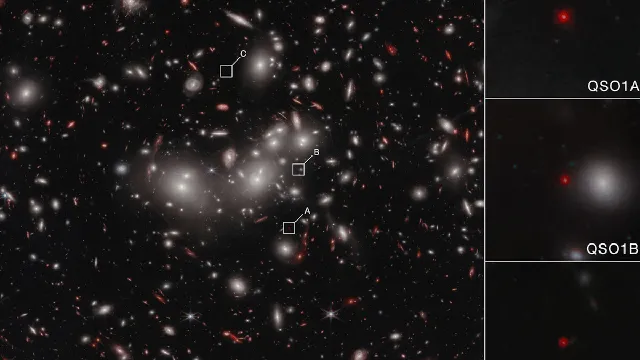
In a groundbreaking study, researchers using NASA's James Webb Space Telescope have identified a black hole that likely formed before its host galaxy, which is significant for our understanding of cosmic evolution. This black hole, with a mass approximately 50 million times that of the Sun, was detected in the galaxy cluster Abell 2744, existing around 700 million years after the Big Bang. The research provides clear evidence that some supermassive black holes could have formed without the need for a more massive host galaxy to support them, suggesting a new model for black hole formation. The study focused on the prototypical black hole Abell2744-QSO1 (QSO1), a prime example of what are known as Little Red Dots, a term referring to early galaxy formations. Researchers utilized advanced technologies, such as integral field unit (IFU) and Near Infrared Spectrograph (NIRSpec), to analyze the motion and chemical composition of gas surrounding the black hole. These measurements revealed that the gas exhibits Keplerian motion, similar to the planets orbiting the Sun, implying that a significant mass is concentrated in the black hole itself rather than being dispersed in stars around it. This observational technique allowed researchers to directly calculate the black hole’s mass for the first time based on the velocities of the surrounding gas. The findings indicate that the black hole constitutes about two-thirds of QSO1's total mass, a stark contrast to what is typically observed in nearby galaxies where supermassive black holes account for only a small fraction of their hosts’ total mass. This discovery fundamentally challenges previous beliefs regarding black hole development and posits the existence of primordial or direct collapse black holes, which have been theorized but not conclusively observed until now. QSO1, stretching approximately 1,300 light-years across, is particularly unique because it is gravitationally lensed by the galaxy cluster Abell 2744, also known as Pandora’s Cluster. This lensing magnifies the image of QSO1, allowing for easier study and analysis compared to other distant galaxies. Overall, the discovery offers new insights into the early universe and raises important questions about the nature of black holes in relation to galaxy formation, potentially leading to a paradigm shift in astronomical science regarding how these massive entities interact with their surroundings and evolve over cosmic time.


