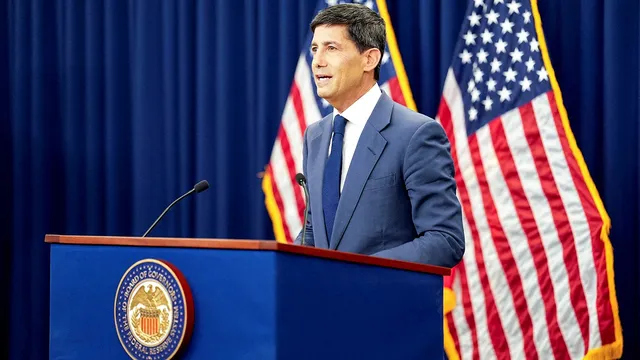
In the United States, the Federal Reserve's Federal Open Market Committee (FOMC) held its first monetary policy meeting under the leadership of Fed Chair Kevin Warsh in June 2026. The meeting took place against a backdrop of rising inflation, primarily driven by surging energy prices earlier in the year. The minutes released from this meeting revealed that policymakers were increasingly worried about inflation and the uncertainty surrounding its future trajectory. They unanimously decided to keep the benchmark federal funds rate unchanged at a range of 3.5% to 3.75%, citing 'high assessed uncertainty' regarding potential future rate cuts or hikes.
During the discussions, most participants acknowledged scenarios where inflationary pressures could ease, allowing inflation to return to the Fed's long-term target of 2%. In such cases, they indicated that it might be appropriate to maintain or lower the target range for the federal funds rate. However, many participants also pointed to scenarios where inflation could remain elevated due to factors such as strong demand related to artificial intelligence, ongoing conflicts in the Middle East, and the impact of tariffs. In these situations, they suggested that some policy firming would likely be necessary to bring inflation back to the target level.
The June meeting also included the release of the so-called 'dot plot,' which indicated that nine of the 18 voting members projected an interest rate hike before the end of 2026, with six members forecasting two 25-basis-point hikes. Additionally, the summary of economic projections revised the forecast for Personal Consumption Expenditures (PCE) inflation at the end of the year from 2.7% to 3.6%, reflecting the recent inflationary trends. Warsh expressed a desire to end 'forward guidance' in how the Fed communicates about future rate moves and did not submit his own economic projection as part of the FOMC's forecasts.
The minutes also highlighted that some policymakers viewed Warsh's first meeting as an opportune moment to consider significant changes to the FOMC's post-meeting statement. A majority of participants noted the advantages of shortening the statement and preferred not to repeat language from previous statements that suggested an easing bias regarding future interest rate decisions. As the Fed navigates these complex economic conditions, the divide among policymakers regarding the future direction of interest rates is becoming increasingly apparent, especially as the earnings season begins and investors brace for upcoming inflation reports.