

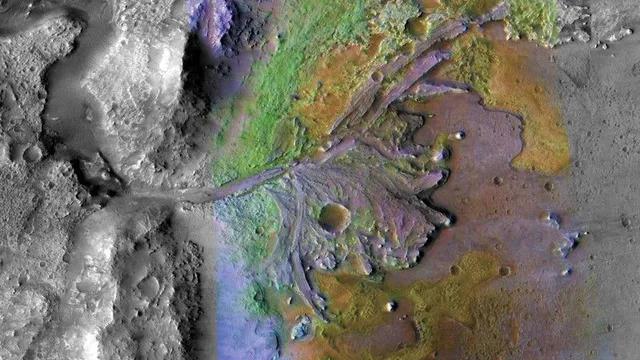
NASA's rover uncovers hidden river delta beneath Martian surface
NASA's rover uncovers hidden river delta beneath Martian surface
- Scientists analyzed radar data from the Perseverance rover that revealed subsurface structures.
- They identified structured layering indicating past water flow and sediment deposition.
- The findings suggest that Jezero Crater contains a hidden delta, pointing to a rich geological history on Mars.
Story
In 2021, NASA's Perseverance rover landed in Jezero Crater to investigate signs of ancient life and to analyze the remnants of a dried-up Martian lakebed. Utilizing radar technology known as RIMFAX, scientists were able to create a two-dimensional vertical slice of the Martian subsurface, allowing them to gather insights into the geological history of the area. The team, led by geologist Cardarelli, discovered a previously hidden layer of rock, referred to as the Margin unit, located beneath the observed Western Delta. The radar analysis resulted in soundings that penetrated over 35 meters deep, surpassing previous measurements from other explored regions in the crater. The findings indicated the presence of structured layering that resembles features seen in river deltas on Earth. The cross-sectional data indicated a history of water flow and sediment layering, suggesting a dynamic environment where multiple episodes of sediment deposition occurred over an extended period. The radar readouts showed parallel layers inclining towards the center of Jezero Crater at various angles, reinforcing the presence of a potentially ancient river delta. Although this interpretation of a hidden delta is among several hypotheses, it strongly suggests an aqueous environment existed long ago. Cardarelli emphasized that the radar data points to the existence of a richer geologic history within Jezero Crater than previously understood, indicating not just past water flow but potentially ongoing secrets left to uncover. The analysis was based on a 6.1-kilometer traverse of Perseverance, yet the rover holds much more data to analyze, approximately 40 kilometers worth. Future publications from Cardarelli’s team are anticipated to provide deeper insights into the ongoing exploration of Martian geology. As more data is retrieved, the connection to potential microbial life on Mars becomes increasingly plausible, with the exploration team excited to further their understanding of Jezero Crater’s prehistoric lake environments. The significance of this discovery lies not only in understanding Mars' past environments and habitats but also in contextualizing the planet's geological evolution. Thus, ongoing and upcoming studies will continue to shed light on the processes that shaped the Martian landscape, offering clues that could inform future missions aimed at searching for signs of past life on the planet.


