

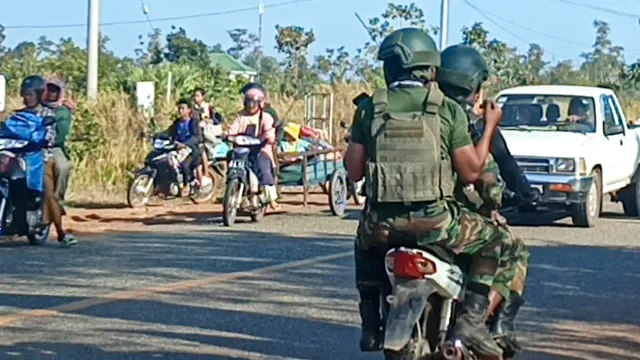
Cambodia and Thailand clash fiercely along contested border
Cambodia and Thailand clash fiercely along contested border
- Cambodia and Thailand engaged in renewed military clashes along their contested border, each blaming the other for the escalation.
- Both nations have reported multiple casualties, with military operations ongoing in several provinces.
- The recent conflict raises concerns over regional stability and humanitarian impacts resulting from the violence.
Story
On December 8, 2025, Cambodia and Thailand experienced escalated fighting along their contested border. The situation arose after both nations accused each other of initiating new hostilities, leading to significant military engagements that have left casualties on both sides. This violence marked the most intense clashes since a ceasefire was brokered by President Donald Trump in July, which had quieted tensions temporarily after a five-day exchange of deadly artillery fire earlier in that month. Prior to the current violence, relations between the two countries had deteriorated due to military build-ups and accusations related to landmines planted by Cambodia, which had injured Thai soldiers. Former Cambodian Prime Minister Hun Sen indicated that his nation had refrained from military action for 24 hours to honor a ceasefire, allowing time for evacuations. However, he asserted that Cambodia was compelled to counterattack in defense of its territory when faced with perceived aggression. He highlighted the readiness of Cambodian forces, citing strong positions and advanced weaponry. Officials from Thailand reported similar sentiments, stating the nation's determination to defend its sovereignty and territorial integrity. They indicated a Navy-led operation aimed at expelling Cambodian forces from Trat Province, which is one of the areas experiencing ongoing clashes. The fighting involved significant military capabilities, with both nations utilizing artillery, rocket launchers, and even drones. Reports from the battlefield claimed that nine civilians and three soldiers had died amid the conflict and there were numerous injuries. The situation remains tense, as both countries have evacuated hundreds of thousands of residents from border areas due to the violence. Tensions between Thailand and Cambodia have a long history, related to sovereignty disputes at their 508-mile border, leading to flare-ups and diplomatic tensions for over a century. As history shows, this dispute is sparked by deep-rooted nationalism and territorial claims, particularly surrounding ancient temples that are situated near the border. The clashes reflect a delicate state of affairs that impacts not just military forces but also civilian populations caught in the crossfire. If diplomatic measures are not taken promptly, the ongoing conflict could escalate further, risking wider regional instability and humanitarian crises as civilians flee the violence, seeking safety away from the border areas.
Context
The history of Cambodia-Thailand border disputes is complex and has deep-rooted historical, cultural, and political dimensions. The contention primarily revolves around the areas surrounding the Preah Vihear Temple, a UNESCO World Heritage site, which has long been a symbol of national pride for both nations. The temple is situated on a 1,700-meter cliff in the Dângrêk Mountains, overlooking Thailand. The mounting tensions related to territorial claims began in the early 20th century when colonial powers demarcated borders in the region. The 1907 Franco-Siamese Treaty established borders which were later challenged, particularly after the Khmer Rouge's rule in Cambodia, leading to significant changes in regional dynamics and a re-evaluation of territorial claims based on historical grounds. The border disputes intensified in the late 20th and early 21st centuries with various military skirmishes and protests from both countries. The situation escalated further in 2008 when Cambodia announced its intention to enlist Preah Vihear as a World Heritage site. This move was met with resistance from Thailand, which claimed that the inclusion of the temple upheld its own historical claims to the surrounding territory. This disagreement prompted both sides to mobilize troops to the border area, leading to armed confrontations and further militarization of the region. Efforts at diplomacy and negotiation have often stalled as nationalistic sentiments have risen, complicating the prospects for peaceful resolution. In 2013, the International Court of Justice ruled in favor of Cambodia regarding the area surrounding Preah Vihear. However, this verdict did not resolve the broader border disputes, as skirmishes continued in other contested areas, including the 4.6 square kilometers of land around the temple. The ruling underscored the need for both nations to adopt cooperative and peaceful dialogues but highlighted the fact that entrenched national identities and regional politics often hinder engagement. Both Cambodia and Thailand are tied to their historical narratives, and these narratives fuel ongoing tensions, making mutual understanding challenging. Efforts for peace led to various negotiations with intermittent agreements on ceasefires and frameworks for future cooperation; however, each nation’s domestic politics often interfere with bilateral talk initiatives. The regional context adds another layer to this dispute, especially with the involvement of ASEAN and other international players seeking stability in the region. Consequently, while there are pathways for potential resolutions through sustained diplomatic efforts, the intricate history and national pride associated with the border disputes mean that lasting peace remains a significant challenge for both Cambodia and Thailand.


