

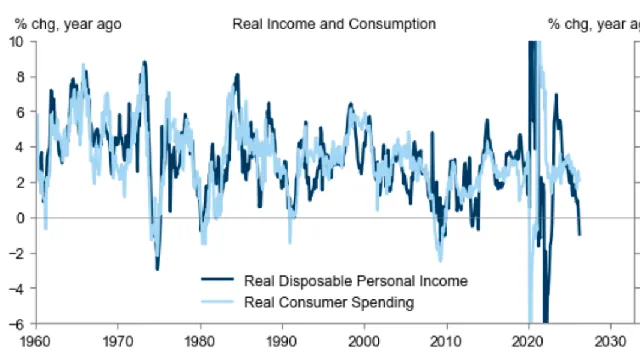
Goldman Sachs warns of real income growth slowdown resembling recession
Goldman Sachs warns of real income growth slowdown resembling recession
- Goldman Sachs reports a significant slowdown in real income growth, rarely seen outside of recession.
- Lower-income households are disproportionately affected by rising costs of goods and energy.
- The overall economic outlook remains cautious as consumers face financial pressures.
Story
In the United States, Goldman Sachs has reported a significant slowdown in real income growth, a trend that is rarely observed outside of recessionary periods. This slowdown has been attributed to several factors, including rising tariffs that increase the cost of goods, elevated energy prices that diminish purchasing power, and wage growth that has not kept pace with inflation. Lower-income households are particularly affected, as they allocate a larger portion of their budgets to essential expenses like food and energy, making them more vulnerable to these economic pressures. The report highlights that the personal savings rate has dropped to just 2.6% as of April 2026, one of the lowest levels recorded outside of the pre-financial-crisis era. Goldman economists suggest that this figure may be understated due to measurement issues related to interest payments in national accounts. Even if the savings rate were adjusted to 3.5%, it would still be among the lowest on record. The decline in savings is concerning, as it indicates that consumers are relying more on immediate cash flow rather than savings to manage their expenses. Goldman Sachs anticipates that real consumer cash-flow growth will slow to just 0.3% year over year by the fourth quarter of 2026, as the temporary boost from tax refunds fades. The projected real income growth for the full year is only 0.9% on a quarter-over-quarter basis. This economic squeeze is not uniform across all income levels; lower-income households are facing the steepest challenges as energy prices remain high. The report notes that while a decline in energy prices, stronger equity market performance, or a rebound in hiring could improve consumer spending, the risks of higher oil prices or a deteriorating labor market could exacerbate the slowdown. Despite these challenges, Goldman Sachs emphasizes that the current situation does not constitute a recession. The labor market remains stable, and the wealth effects from elevated equity prices are providing some offset to the income weakness. However, the underlying trend of real income growth is concerning, and the report suggests that once temporary distortions, such as those caused by tax policy changes and Social Security payouts, are removed, the fundamental issues will become more apparent. The economic landscape is complex, and while there are factors that could mitigate the slowdown, the overall outlook remains cautious as consumers navigate these financial pressures.


