

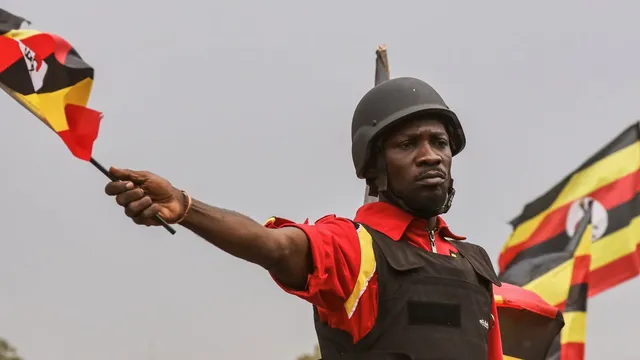
Bobi Wine flees Uganda amid military hunt for his life
Bobi Wine flees Uganda amid military hunt for his life
- Bobi Wine confirmed he fled Uganda amid concerns for his safety following allegations of a rigged election in January 2021.
- He mentioned receiving threats from the regime and being hunted by military forces after the election results were announced.
- His departure signifies ongoing tensions and a bleak political landscape in Uganda, with calls for accountability and change.
Story
In January 2021, following a disputed presidential election in Uganda, opposition leader Bobi Wine, born Kyagulanyi Ssentamu, confirmed he fled the country to escape a military search. The election was marred by allegations of rigging, where the incumbent President Yoweri Museveni was declared the winner with 71.6% of the vote, a claim vehemently rejected by Wine and his supporters. Since the election, tensions have escalated, with Wine remaining in hiding due to threats from the regime and subsequent military raids on his home. Reportedly, military forces began searching for Wine immediately following the January 14 vote, during which he had already gone into hiding to avoid being detected. Concerns for his safety intensified as the army chief, General Muhoozi Kainerugaba, publicly called for Wine's capture and issued threats, while simultaneously referring to him in derogatory terms on social media. Despite claims from Ugandan police that they were not actively searching for him, Wine's fears were compounded by the general's hostile rhetoric, indicating that his life was in danger. After weeks of hiding, Wine announced on social media that he had left Uganda and was engaging in critical activities abroad. In a video message, he expressed gratitude to those who protected him during his time in hiding and reiterated his belief that the election results were fraudulent; he called for international sanctions against Museveni's regime. The military continued to surround his residence following the election, indicating a sustained threat from government forces. In his statements, Wine emphasized that even while abroad, he remains vulnerable to the regime’s efforts to silence political opponents. He left Uganda after extensive planning and voiced concerns for members of his political party, the National Unity Platform, who were still at risk in Uganda. Wine had previously led significant public dissent against Museveni’s long-standing rule, and his departure marks a significant moment in the ongoing political crisis within Uganda. This situation underscores the escalating authoritarian tendencies exhibited by Museveni's government and why Wine’s supporters continue to seek political change and accountability.
Context
The history of political dissent in Uganda is a complex narrative that reflects the struggles of its citizens against oppressive regimes and the persistent quest for civil liberties. Political dissent in Uganda has its roots in the colonial era when the British colonial government exercised control over the local population. This period laid the foundation for future resistance against authoritative governance. Following Uganda's independence in 1962, the political landscape was marked by instability as various leaders struggled for power. The subsequent rise of Idi Amin's regime in the 1970s triggered a significant wave of dissent characterized by brutal repression and human rights violations. Opposition groups formed in response to Amin's tyrannical rule, leading to a series of uprisings and armed struggles, including campaigns by groups like the Uganda People's Army (UPA) and later the National Resistance Army (NRA) led by Yoweri Museveni. These movements sought to dismantle dictatorial practices and restore democratic governance, highlighting the resilience of Ugandans in the face of oppression. The political climate in Uganda continued to evolve post-Amin, particularly under Museveni's rule which began in 1986. While initial reforms promised a more democratic environment, the reality often diverged significantly from these ideals. Museveni's government faced accusations of authoritarianism, particularly as laws were enacted to suppress political opposition and limit freedoms of expression and assembly. The banning of political parties in the early 1990s under the "no-party" system showcased the lengths to which the regime would go to maintain control. Activists, journalists, and opposition leaders employed dissent as a means to expose government corruption and advocate for democratic principles, despite significant risks. The era witnessed the emergence of civil society organizations and human rights networks that played a crucial role in challenging the regime's narrative and pushing for reforms. From the late 2000s onward, the landscape of political dissent has shifted yet again, influenced by both internal dynamics and global trends. The rise of technology and social media provided new platforms for organizing, mobilizing, and disseminating information, empowering younger generations to express dissent in innovative ways. Protests have erupted around various social issues, including corruption, unemployment, and electoral malpractices, with events like the "Walk to Work" protests of 2011 and the opposition leader Robert Kyagulanyi's activism drawing national and international attention. However, the government's response has often been heavy-handed, involving violent crackdowns on public demonstrations and the arrest of political opponents. This pattern reveals an ongoing struggle between the desire for democratic governance and the entrenched power of ruling elites who resist change. Today, the legacy of political dissent in Uganda continues to shape its present landscape. The struggle for democracy is ongoing, with civil society and the youth remaining pivotal in advocating for change. Various political movements are striving to challenge the status quo and address the needs and rights of the populace. While the road ahead is fraught with challenges, the resilience of Ugandan citizens in voicing dissent and demanding accountability underscores a significant aspect of the country’s political history. As Uganda confronts its current political realities, understanding this historical context is vital for recognizing the importance of dissent in shaping a more democratic future.


