

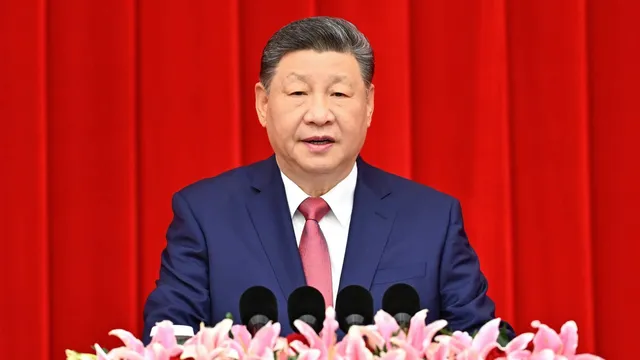
Xi Jinping renews promise to annex Taiwan amid tech advancements
Xi Jinping renews promise to annex Taiwan amid tech advancements
- Xi Jinping praised China's advancements in technology, particularly in artificial intelligence and semiconductors.
- The President reiterated China's claim over Taiwan, calling for reunification.
- The address indicates China's strategy to assert territorial ambitions while striving for technological self-reliance.
Story
In a recent address broadcasted by state media on New Year’s Eve, Chinese President Xi Jinping emphasized the country's notable advancements in technological sectors such as artificial intelligence and semiconductors. He highlighted these developments as critical to energizing high-quality economic growth and thanked the Chinese populace for their contributions over the past five years. With an impending discussion on its new five-year plan in March, China is also focusing on enhancing its self-reliance in science and technology, especially in light of the United States imposing strict controls on high-tech items, including semiconductors. During this address, Xi reflected on China's growing global significance, citing numerous high-level political events and exchanges hosted throughout the year. He also reiterated strong claims regarding Taiwan, a self-ruled democracy that China views as its territory. Xi referred to the perceived connection between the people on both sides of the Taiwan Strait, asserting that the reunification of the so-called motherland is an unstoppable trend. This statement comes amidst rising tensions, as demonstrated by recent military drills conducted by China around Taiwan, coinciding with a planned arms sale by the U.S. to Taiwan. In the wake of these military exercises, Taiwan President Lai Ching-te condemned China's actions while emphasizing the need for responsible behavior from his territory, choosing not to escalate the situation or provoke further disputes. Given the deteriorating relationship between China and Taiwan, Xi's assertions during his speech carry significant weight, signaling a continuation of China's assertive stance on the issue of Taiwan's sovereignty. The emphasis on technological developments alongside aggressive territorial ambitions raises concerns about the implications for regional stability, highlighting the dual focus of China's domestic growth and its geopolitical strategy. As China gears up to discuss its new economic plan, the underlying message from Xi’s address underscores a determination to push forward in technology and assert its claims over Taiwan. As tensions between China and the U.S. continue to rise, the upcoming months will reveal how both nations navigate these challenges, particularly concerning Taiwan and high-tech industry relations, which are likely to be pivotal points in future discussions.
Context
The history of China-Taiwan relations is a complex narrative shaped by historical events, political ideologies, and international dynamics. The roots of this relationship can be traced back to the Chinese Civil War (1927-1949), which culminated in the defeat of the Chinese Nationalist Party (Kuomintang, KMT) by the Communist Party of China (CPC). In 1949, the KMT retreated to Taiwan, establishing a separate government there, while the CPC established the People’s Republic of China (PRC) on the mainland. From this point onward, Taiwan and the mainland have developed into two distinct political entities, each claiming sovereignty over China as a whole. Throughout the latter half of the 20th century, Taiwan operated as a separate entity, initially under martial law, and gradually transitioned towards a democratic system. The PRC, meanwhile, maintained its position that Taiwan is a part of its territory and has emphasized a policy of reunification with the goal of achieving national integrity. Internationally, the relationship has often been influenced by the actions of other nations, particularly the United States, which has provided military support to Taiwan despite formally recognizing the PRC in 1979 under the One China policy. The late 20th and early 21st centuries saw fluctuating tensions and dialogues between Taiwan and China. The rise of Taiwan's pro-independence movement in the late 1990s further complicated cross-strait relations, as several Taiwanese leaders promoted a sense of unique national identity separate from China. In contrast, various Chinese administrations have reacted with increased military posturing and political pressure, labeling any steps towards formal independence as threats to stability in the region. Key moments of cooperation, such as the 2008-2016 administration under President Ma Ying-jeou, which promoted engagement and economic ties between the two sides, offered a glimmer of hope for peaceful coexistence. However, recent years have witnessed increasing tensions following the election of Tsai Ing-wen as President of Taiwan in 2016, who advocates for Taiwan's identity and autonomy over unification. The PRC's response has included military exercises near Taiwan and a tightening of diplomatic relations by isolating Taiwan from global platforms. The situation remains precarious as both sides navigate their historical grievances and contemporary challenges, including economic interdependence, national security concerns, and the broader geopolitical rivalry involving major powers like the United States. The ongoing developments reflect a profound complexity that will shape the future of not only Taiwan and China but also the security and political landscapes of East Asia.


