

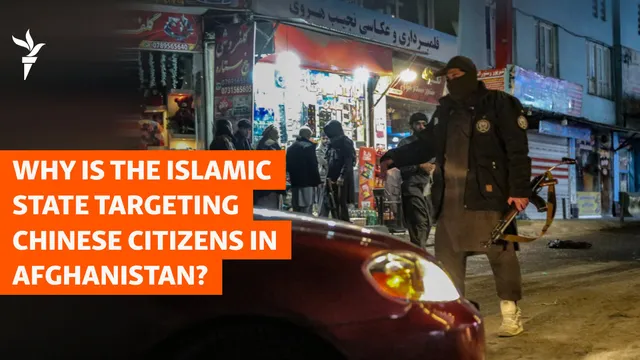
Islamic State intensifies attacks on Chinese nationals in Afghanistan
Islamic State intensifies attacks on Chinese nationals in Afghanistan
- The January 2023 suicide bombing in Kabul targeted a Chinese restaurant, killing seven and injuring others, including a Chinese national.
- IS-K has declared Chinese nationals a target due to policies in Xinjiang, where Muslim minorities face repression.
- The Taliban faces challenges in maintaining security and attracting foreign investment in the wake of IS-K's campaign.
Story
In January 2023, a suicide bombing occurred at the Lanzhou Chinese Noodles restaurant in Kabul, Afghanistan, resulting in the deaths of at least seven people and injuring 13 others, including a Chinese citizen. The attack was claimed by the Islamic State-Khorasan Province (IS-K), which stated its intent to target Chinese nationals due to Beijing's policies in Xinjiang, where significant numbers of Uyghurs and other Muslim minorities have been imprisoned in detention camps. Several attacks against Chinese interests have also been reported in Pakistan and Tajikistan, indicating a broader campaign against China. Analysts believe that the attacks highlight vulnerabilities in Afghanistan under Taliban rule, which has been struggling to maintain security since taking power in August 2021. IS-K's efforts may aim to undermine the Taliban's governance by instilling fear among potential Chinese investors, making them less willing to engage with the Taliban. This is particularly significant since previous investments from China were seen as legitimizing the Taliban's authority and enhancing their stability as the ruling power. The relationship between the Taliban and IS-K is complex; while the Taliban views IS-K's ambitions for establishing a regional caliphate as a threat, IS-K continues to leverage its anti-China sentiment among extremist groups. In doing so, IS-K aims to send a message to the Taliban that it remains capable of executing significant attacks, which challenges the Taliban's claims of having eradicated IS-K's presence in Afghanistan. The Taliban has had to bolster security for Chinese citizens and has conducted operations against IS-K, including raids on hideouts linked to attacks against Chinese nationals. Despite the potential for increased cooperation between the Taliban and countries like Tajikistan in combating IS-K, the targeting of Chinese nationals poses a broader risk to stability in Afghanistan. As IS-K escalates its campaign, future attacks are anticipated, not just in Afghanistan but potentially crossing borders into neighboring countries, where Chinese citizens could become prime targets for extremist or criminal groups interested in harming Chinese interests.
Context
The impact of Chinese policies in Xinjiang on foreign relations is a multifaceted issue that has garnered significant international attention over the past several years. As reports of human rights abuses, mass detentions, and cultural suppression of the Uyghur population have emerged, countries worldwide have grappled with how to respond to China's actions. This situation has consequently strained China's relationships with several nations, particularly those in the West, leading to a complex interplay of diplomacy, economic tensions, and alignment among global powers. The United States, in particular, has taken a strong stance against China's policies in Xinjiang, implementing sanctions on Chinese officials and organizations believed to be complicit in the violations. This has led to a deterioration of diplomatic ties between the U.S. and China, impacting discussions in other areas, including trade and international security matters. Furthermore, this situation has caused concern among other nations, who face pressure to take a stance on human rights and align themselves with either the Chinese position or the human rights advocacy echoed by Western nations, impacting global alliances and cooperation frameworks. Moreover, the responses from various nations are complicated by their economic dependencies on China. For countries heavily reliant on Chinese trade or investment, openly criticizing China may result in economic repercussions, leading to varying levels of condemnation or support. While some countries, including those in Europe and Australia, have been vocal in their criticism, others in Asia and Africa have remained largely silent or have supported China's narrative, influenced by economic ties or their own political considerations. This divergence highlights how China's influence as a global economic powerhouse complicates the moral and ethical aspects of foreign relations, as nations balance their trade interests against the principles of human rights and international law. In the context of the global response, multilateral organizations and human rights groups have also taken a significant interest in the situation in Xinjiang. The United Nations has faced calls for independent investigations into the allegations of human rights violations, but China's strong influence has often stifled decisive action. Meanwhile, business is increasingly being drawn into this geopolitical quandary, as companies face scrutiny over their supply chains and the ethical implications of sourcing materials from Xinjiang, where forced labor has been reported. As a result, companies are being compelled to reconsider their operations and supply chain practices to align with the growing emphasis on corporate social responsibility and human rights adherence. The situation in Xinjiang has profound implications for the future landscape of international relations. As awareness of human rights issues increases and public sentiment shifts towards demanding accountability, the pressure on nations to take a stand could escalate further, leading to a potential reshaping of alliances. Countries may find it increasingly challenging to navigate the complexities of their relationships with China while also adhering to international norms that advocate for human rights. Ultimately, the repercussions of China's policies in Xinjiang extend beyond bilateral relationships to impact global diplomacy and international systems as a whole, fostering a realm of contention that could reshape diplomatic engagements for years to come.


