

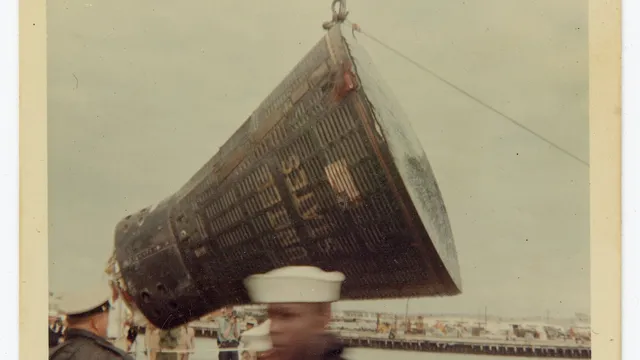
Neil Armstrong survives life-threatening emergency during Gemini 8 mission
Neil Armstrong survives life-threatening emergency during Gemini 8 mission
- In March 1966, during the Gemini 8 mission, Neil Armstrong and David Scott faced a critical emergency in orbit around Earth.
- After successfully docking, both spacecraft began tumbling uncontrollably, prompting Armstrong to make a quick decision to deploy thrusters.
- The recently donated photographs capture the astronauts’ smiles post-mission, illustrating their professionalism and resilience amidst danger.
Story
In March 1966, during the Gemini 8 mission, astronauts Neil Armstrong and David Scott encountered a severe emergency while orbiting Earth. After successfully docking with another spacecraft, both ships began to tumble uncontrollably, escalating the situation toward a life-threatening crisis. Armstrong, demonstrating remarkable quick thinking, deployed the spacecraft's thrusters to halt the spinning motion, although this action consumed essential fuel needed for their return trip. Due to the unexpected situation, ground control deemed it necessary for them to end their mission prematurely. They splashed down in the ocean nearly 10 hours after launch, off the coast of Okinawa, Japan, where they were subsequently rescued by a recovery ship that transported them to Naha Air Base. The incident highlighted not only the challenges faced by astronauts during the Gemini program but also the critical decision-making skills essential for operating in high-stake environments. Newly discovered photographs taken by Ron McQueeney, who accompanied the astronauts post-mission as a photographer, were recently donated to the Armstrong Museum in Ohio. These images, never before released, capture the astronauts on the deck of a U.S. Navy vessel, displaying a sense of calm and professionalism even after their harrowing experience. This content complements the existing displays at the museum, including the Gemini 8 capsule itself, helping to convey a more complete account of the mission's story to visitors. Science historians have expressed the importance of these photographs, particularly how they document Armstrong and Scott's demeanor in the wake of such a high-stress event. Visitors to the museum are reminded of the inherent risks taken by astronauts and the necessity for preparedness in space missions. As Emily Margolis, a curator at the National Air and Space Museum, noted, the difficulty of space travel often goes unappreciated, with a tendency to overlook the immense effort and resources required to achieve such feats. Showing the astronauts smiling post-mission emphasizes their professionalism and ability to cope with extreme circumstances! These newly unearthed images not only serve to brighten the history associated with the Gemini program but also provide valuable perspectives on the human aspect of space exploration. By contrasting the intense pressures of the situation with the joyful expressions in the photos, it underscores a significant narrative regarding the resilience of the human spirit in the face of adversity. As stories like this one gain attention, they shed light on the foundational moments of space travel, and the public's admiration for these pioneering astronauts continues to grow.


