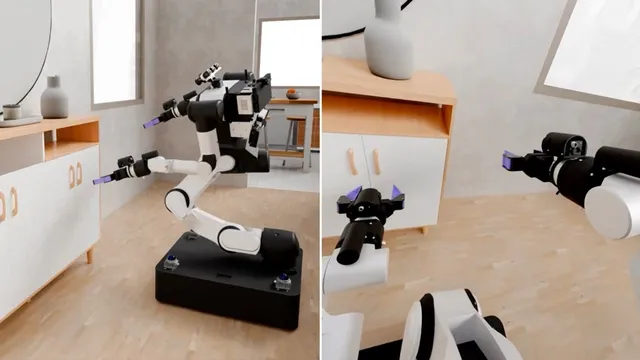
Researchers at MIT have developed a system called SceneSmith, which utilizes artificial intelligence to create detailed 3D environments where robots can practice household tasks. This technology allows robots to learn from their mistakes in a controlled virtual setting before they are deployed in real homes. SceneSmith generates over 1,300 training spaces, enabling robots to interact with various objects and layouts, which helps identify weak action plans during training. However, the technology is still in the research phase, and independent confirmation of its effectiveness remains limited, as further testing in real-world scenarios is necessary to validate its capabilities.
The process begins with a simple written request, which SceneSmith uses to create a floor plan and populate it with furniture and objects. This results in a functional virtual room where robots can perform tasks such as opening cabinets and moving items. The researchers emphasize that the virtual environments are not just visually realistic but also behave like physical spaces, allowing for meaningful interaction. Despite the promising results, the researchers acknowledge that the technology requires extensive testing to ensure reliability in real-world applications.
In a comparative study, 205 participants preferred the virtual rooms generated by SceneSmith over previous scene-generation methods. The system's ability to create diverse environments is seen as a significant advantage, as it exposes robots to a variety of furniture and object arrangements. However, the time required for SceneSmith to produce a scene—potentially several hours—highlights the complexity of the task and the need for thorough inspection of the generated objects. As the technology continues to evolve, the researchers remain focused on refining the system to enhance its utility for robotic training.
Overall, while SceneSmith represents a significant advancement in the field of robotics and AI, the current stage of development indicates that further research and validation are essential before it can be fully implemented in practical settings. The report has limited confirmation from reliable sources, and ongoing studies will be crucial in determining the long-term viability of this innovative approach.