

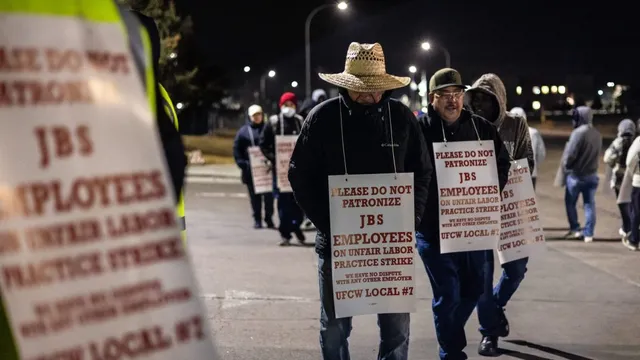
Workers at major meatpacking plant launch historic strike due to unfair labor practices
Workers at major meatpacking plant launch historic strike due to unfair labor practices
- 3,800 workers began a strike at the Swift Beef Co. plant in Greeley, Colorado, at 5:30 a.m. MDT on March 16, 2026.
- The workers are protesting unfair labor practices during stalled contract negotiations.
- This strike is notable as it is the first major walkout at a U.S. beef slaughterhouse since the 1980s.
Story
The United States is witnessing a significant labor action as about 3,800 workers at the Swift Beef Co. plant in Greeley, Colorado, initiated a strike on March 16, 2026. This move marks the first major walkout at a U.S. beef slaughterhouse since the 1980s. The workers, represented by the United Food and Commercial Workers Local 7, are protesting against retaliation and other unfair labor practices attributed to their employer, JBS USA, as contract negotiations stall. The previous contract had expired just before the strike began, leading to heightened tensions between the labor union and management. The strike comes amidst challenging economic conditions for beef producers in the U.S., with the cattle population currently at a 75-year low, an alarming 86.2 million animals as of January 1, 2026, which reflects a 1% decrease from the previous year. This decline in cattle numbers has further escalated beef prices, contributing to economic anxiety among consumers. The current administration, led by President Donald Trump, has sought solutions like trade deals with Argentina to alleviate some of the pressure on food prices, including beef. This backdrop compounds the urgency of the workers' situation at the Greeley facility. Accusations have arisen suggesting that JBS USA has engaged in intimidation efforts targeted at union members, aiming to persuade them to abandon their union affiliations. Union representatives allege that employees were subjected to one-on-one intimidation meetings designed to weaken union solidarity. Kim Cordova, the president of United Food and Commercial Workers Local 7, reported that a striking 99% of workers authorized the strike, showing overwhelming support for collective action against what they deem unfair labor practices. As the strike commenced at 5:30 a.m. MDT, JBS USA indicated that they would keep operations running, offering work to employees who chose not to participate in the strike and stating that two shifts would operate on that day. The company reassured stakeholders that they would take measures to manage production across other facilities to minimize disruption in service to customers. Yet, the situation remains ongoing as union leaders expressed dissatisfaction with the lack of negotiation efforts from the company, with no formal discussions taking place over the weekend preceding the strike.
Context
The history of strikes in the U.S. meatpacking industry is marked by a series of labor movements that reflect the broader struggles of workers in the American workforce. Beginning in the late 19th and early 20th centuries, meatpackers began organizing in response to harsh working conditions, long hours, and low pay. A significant moment was the 1904 Chicago meatpacking strike, where workers protested against unbearable conditions in the slaughterhouses. The demand for better wages and working conditions set the stage for future labor movements within this industry. In 1933, the formation of the United Packinghouse Workers of America (UPWA) marked a pivotal moment in the labor movement, offering meatpacking workers a voice and a chance to negotiate better terms in a previously fragmented industry. Throughout the 1930s and 1940s, the meatpacking industry was a hotbed of labor unrest, particularly during the New Deal era, when many workers sought to improve their lot in life through organized action. Strikes were often met with fierce resistance from employers, who employed tactics ranging from intimidation to outright violence. The 1948 nationwide strike led by the UPWA is notable for its scale, demonstrating the deep-rooted frustrations among workers. Tensions continued to simmer, culminating in a series of strikes during the late 1960s and early 1970s, which focused on addressing issues like workplace safety, racial discrimination, and the demand for union recognition. By the late 20th century, the meatpacking industry was undergoing significant changes due to globalization and technological advancements. These changes contributed to a decline in unionized workforce engagement as companies began to outsource production or automate processes. The 1980s witnessed a notable decline in strikes as many workers faced job insecurity and a weakening of labor rights under anti-union legislation. Meanwhile, organizations like the United Food and Commercial Workers (UFCW) continued to fight for workers' rights but faced challenges adapting to the changing landscape. In recent years, concerns have arisen about working conditions in meatpacking due to the COVID-19 pandemic, leading to renewed interest in labor rights. Strikes in 2020 by workers at plants across the country highlighted ongoing issues such as unsafe working environments and inadequate health protections. As unions mobilize once more in a changing economic landscape, the history of strikes in the U.S. meatpacking industry serves as both a reminder and a guide for workers seeking to improve conditions, emphasizing the importance of collective action in achieving labor rights.


