

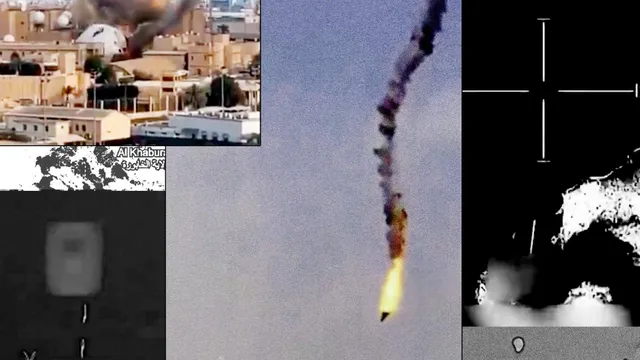
Hamas urges Iran to cease assaults on Gulf nations amidst ongoing conflict
Hamas urges Iran to cease assaults on Gulf nations amidst ongoing conflict
- Iran has launched numerous drone attacks targeting Gulf nations in response to U.S. and Israeli strikes.
- Hamas, expressing concern, called on Iran to refrain from attacks on neighboring countries to maintain regional relationships.
- The ongoing conflict has resulted in significant casualties and infrastructure damage across several Gulf states.
Story
Iran has recently engaged in multiple drone attacks that have affected several Gulf states, including the UAE, Kuwait, and Oman. These attacks are a response to ongoing strikes by the U.S. and Israel, which aim to weaken Iran's military capabilities, particularly its nuclear and drone arsenal. An analysis conducted by NBC News showcased numerous verified videos depicting these Iranian strikes and the interceptions by U.S. forces across multiple countries. Alarmingly, reports indicate that over 1,400 drones were targeted at the UAE alone, with significant casualties reported due to this escalating conflict between Iran and its adversaries. Hamas, a Palestinian armed group and a key ally of Iran, made a public appeal urging Tehran to halt its military offensives on Gulf nations. This plea underscores the tension within the region, as Hamas acknowledges Iran’s right to defend itself against attacks from the U.S. and Israel, while simultaneously advocating for regional peace and unity. The group expressed deep concern about the ongoing conflict and the ramifications it has on their relationships with neighboring states, emphasizing the importance of preserving regional bonds amidst the escalating violence. Reports indicate that the Iranian counterstrikes have significantly affected civilian infrastructure in the Gulf, leading to casualties among both security personnel and foreign workers. Sadly, the statistics from various countries show that at least 18 individuals have lost their lives due to these strikes, reflecting the human cost of this conflict. In Kuwait and the UAE, instances of civilian deaths have raised alarms about the implications of Iran's military strategy and the ongoing retaliatory actions in this regional crisis. As the U.S. continues to apply pressure on Iran through military means, tensions are likely to persist, creating a broader regional instability. The drone technology employed by Iran, notably the Shahed-136 model, presents a unique threat to Gulf nations, which may find themselves increasingly vulnerable to aerial attacks. The persistence of this conflict suggests that the situation could further deteriorate unless diplomatic efforts are made to address the grievances of all parties involved and cease hostilities on both sides. Without intervention, the cycle of violence may perpetuate, compromising the security and stability of the entire region.
Context
The impact of Iranian drone warfare on Persian Gulf stability has emerged as a critical concern in recent years as tensions between Iran and its regional neighbors, particularly Saudi Arabia and the United Arab Emirates, escalate. Iran has developed an advanced drone program that has allowed it to project power throughout the region, raising alarms about maritime security and contributing to the already volatile geopolitical landscape of the Persian Gulf. Iranian drones have been employed in various operations, from surveillance and reconnaissance to offensive strikes, showcasing their versatility and efficacy in modern warfare. The integration of drone technology into Iran's military strategy provides it with an asymmetric advantage, making it difficult for conventional forces of its adversaries to respond effectively. This proliferation of unmanned aerial vehicles (UAVs) challenges existing military doctrines and necessitates a reevaluation of defense strategies by Gulf states and international powers engaged in the region. In recent conflicts, such as attacks on oil facilities in Saudi Arabia and shipping routes in the Strait of Hormuz, Iranian drone warfare has highlighted vulnerabilities in both maritime and land-based infrastructure. The use of drones to carry out precision strikes has not only disrupted the flow of oil—a critical economic lifeline for Gulf states—but has also escalated tensions between Iran and the United States, as well as its allies. These developments have led to increased military presence and preparedness among Gulf nations, further exacerbating the risks of miscalculation that could lead to broader military confrontations. As Iranian drone capabilities continue to evolve, their potential use in intelligence gathering, cyber warfare, or asymmetric tactics presents an added dimension to the threat landscape in the Gulf region. The implications of Iranian drone warfare extend beyond immediate military confrontations; they pose significant challenges for diplomatic efforts aimed at stabilizing the region. The introduction of drones into the regional security equation complicates existing power dynamics and undermines traditional forms of deterrence that have been established in past conflicts. Furthermore, the potential for proxy groups in the region to acquire and use these advanced drone technologies creates additional layers of uncertainty and instability. The risk of escalation becomes acute as states may feel compelled to launch preemptive strikes against perceived threats arising from Iranian drone activity, potentially leading to a cycle of retaliation that destabilizes the entire Gulf region. To address these emerging threats, a multifaceted approach to security and diplomacy is required. This includes bolstering regional defense systems, enhancing intelligence-sharing among Gulf Cooperation Council (GCC) members, and engaging Iran in dialogue to mitigate tensions surrounding its drone program. The international community, particularly Western powers, must also play a role in facilitating discussions that aim to establish norms regarding the use of drone technology in armed conflicts. Ultimately, maintaining stability in the Persian Gulf necessitates a collective effort to address the complexities introduced by Iranian drone warfare, reinforcing the importance of dialogue, cooperation, and strategic preparedness among regional and global stakeholders.


