

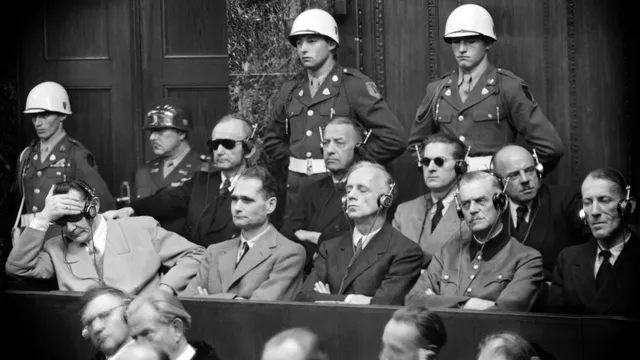
Nuremberg tribunal confronted morality and justice after the Holocaust
Nuremberg tribunal confronted morality and justice after the Holocaust
- The Allied Forces tried 22 senior Nazi officials and six organizations from November 20, 1945, to October 1, 1946.
- The tribunal was a landmark event that confronted moral failures and laid the groundwork for legal accountability.
- The lessons from Nuremberg persist today, reinforcing the commitment to justice and the importance of holding power to account.
Story
Between November 20, 1945, and October 1, 1946, the Allied Forces conducted the International Military Tribunal in Nuremberg, Germany, where they tried 22 senior Nazi officials along with six organizations. This tribunal aimed to establish accountability for atrocious wartime actions and marked a historical moment when law confronted moral failures. Although it did not fully encompass the complexity of the Holocaust, the tribunal exemplified a significant step towards instituting a legal framework for addressing crimes against humanity. It highlighted the importance of evidence and records in justice, moving away from merely moral arguments to factual legal accountability. While judges oversaw the proceedings and translators facilitated communication, the atmosphere revealed a paradox where the gravity of the situation collided with the mundanity of courtroom procedures. This struggle was emblematic of the ultimate goal of rebuilding a moral vocabulary post-war, striving for a nuanced discussion around crimes based on ideology rather than mere wartime aggression. Notably, the effort to articulate the Holocaust's specifics faced challenges, as the prosecution focused on wartime aggression without fully encapsulating the genocidal intent that drove the Nazis' actions. The legacy of Nuremberg remains pivotal, for it established a precedent that truth could be sought and defined within legal frameworks, even in the face of overwhelming horror. Laws enact limitations within which morality finds expression, and changing legal paradigms ensures humanity's need to confront its darkest moments through structured means. The tribunal demonstrated not just the mechanics of destruction but also humanity's enduring struggle to comprehend moral failings through accountability and justice. Through its challenges and limitations, the Nuremberg Trials serve as an affirmation that even when confronted with unspeakable atrocities, the pursuit of justice and truth is essential for civilized society. Eighty years on, the lessons from Nuremberg continue to resonate, reminding contemporary societies of their responsibility to confront historical atrocities while holding power accountable. This process stands as a testament to humanity's intrinsic value, emphasizing the idea that efforts to address past wrongs remain a crucial domain of civilized interactions among nations and peoples. The ability to hold power accountable is not only a legal necessity but also an essential moral undertaking, thereby ensuring that future generations learn from the past and work tirelessly to prevent the repeat of such horrors.
Context
The Nuremberg Trials, conducted after World War II, were a groundbreaking series of military tribunals held to prosecute prominent leaders of Nazi Germany. The trials commenced in November 1945 and spanned until October 1946, featuring 24 defendants charged with war crimes, crimes against humanity, and genocide. The trials were significant for establishing the principle that individuals and leaders could be held accountable under international law for their actions during armed conflict, thus laying the groundwork for contemporary international human rights law. They underscored the collective rejection of the defense that orders were just following the law of the land, emphasizing individual moral and legal responsibility, a precedent in international judicial proceedings. Key outcomes of the Nuremberg Trials included the establishment of notable legal precedents, including the definitions of war crimes and crimes against humanity. The judgments delivered during the trials varied, resulting in executions, imprisonment, and acquittals, which highlighted complexities in attributing guilt amid a war environment. The trials also produced foundational texts that served as references for the formulation of international legal standards, notably influencing later international tribunals and courts, such as the International Criminal Court (ICC). The notions of justice inspired by these proceedings provided a framework for addressing grievances and enforcement of laws that transcended national boundaries. The Nuremberg Trials also had profound social and political implications, sparking global conversations about justice, retribution, and reconciliation. They brought the atrocities committed during the Holocaust and other wartime actions into full public view, fostering a broader awareness and acknowledgment of human rights abuses. The ramifications of these trials extended beyond their immediate legal impact; they would inspire global movements aimed at promoting human rights and preventing future genocides. Furthermore, they contributed to an important moral reckoning in societies grappling with past horrors, creating a template for transitional justice mechanisms in post-conflict scenarios around the world. In summary, the significance of the Nuremberg Trials cannot be overstated. They were pivotal in the evolution of international law, setting a precedent for prosecuting war crimes and embedding the value of judicial accountability for heinous acts. The trials symbolized a crucial moment in history, confronting the challenges of a post-war world and establishing a framework through which nations could navigate issues of justice and humanity. Consequently, their legacy continues to inform current debates surrounding human rights and international justice, playing a critical role in shaping the ideals of a more just global society.


