

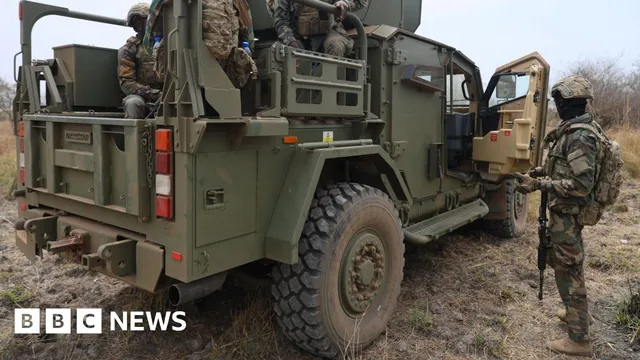
Ghana's military faces deadly assault on civilian convoy
Ghana's military faces deadly assault on civilian convoy
- Seven gunmen and three civilians were killed in an attack on a military convoy in Binduri.
- Ten suspects have been arrested as investigations continue into the violent incident.
- The attack exacerbates ongoing tensions due to a protracted chieftaincy dispute in the region.
Story
In Ghana, a violent incident occurred in Binduri, a region in the northeastern part of the country. The attack was aimed at a military convoy, which was escorting 140 civilians along a particularly hazardous highway connecting Bawku and Bolga. During a fierce exchange of gunfire, three civilians lost their lives alongside seven armed assailants. Following the incident, ten suspects were arrested as part of ongoing investigations into the attack. This event underscores the escalating violence tied to a long-standing chieftaincy dispute in the region, which has become a significant security concern for local authorities. The protracted conflict, primarily between the Kusasi and Mamprusi ethnic groups, has been exacerbated by decades of historical grievances over chieftaincy rights in the area. Tensions came to a head when the Supreme Court upheld the Kusasis' claim to the traditional chieftaincy of Bawku, leading to increased divisions and sporadic violence in the community. The intermittent clashes between the two groups have necessitated government intervention and the deployment of additional military personnel to the region. In a bid to counteract the violence, the Ghanaian government has implemented several measures. These include systematic curfews, military-police joint patrols, and providing armed escorts for civilians traveling through dangerous areas. Last year, schools in the vicinity faced attacks, prompting government authorities to intensify their military presence in the region to restore order and secure the northern frontier near Burkina Faso, an area where armed Islamist militant groups reportedly operate. The recent attack on the military convoy not only highlights the immediate dangers faced by civilians in the area but also raises concerns about the broader security implications for Ghana. The military has been actively conducting operations to track down other assailants and recover armaments used during the attack, including a G3 automatic rifle seized from one of the attackers who sought refuge in a mosque after the incident. Continued violence in Binduri and its surroundings poses a significant risk to the peace and stability of the region, making it essential for the government to address the underlying causes of this conflict while ensuring the safety of its citizens.
Context
The history of chieftaincy disputes in Ghana is a complex subject that encapsulates an interplay of traditional authority, colonial administration, and modern governance. Chieftaincy is an integral aspect of Ghanaian society, representing not only local governance but also cultural identity. Disputes over chieftaincy arise from various factors including succession issues, the influence of political parties, land disputes, and the recognition of chiefs by the state. Succession disputes often stem from differing interpretations of customary laws and practices, which can lead to factions within communities vying for legitimacy and power. The role of women in this sphere has also evolved, as some communities have started to acknowledge their rights to traditional leadership, challenging long-standing norms regarding gender roles in chieftaincy succession. The British colonial administration introduced a system that often undermined traditional authority, which caused rifts between colonial and indigenous governance systems. The British recognized certain chiefs and diminished the power of others, leading to a hierarchy that did not necessarily align with traditional practices. This legacy produced a new layer of disputes, as communities grapple with the remnants of colonial influence alongside contemporary governance challenges. Following independence in 1957, chieftaincy disputes continued as political dynamics in Ghana shifted, with various regimes either supporting or opposing traditional authorities, often using them to further political agendas. The resulting fragmentation and competition among chieftaincy factions can exacerbate local tensions and undermine social cohesion. Recent years have seen the establishment of legal frameworks to address chieftaincy disputes more systematically. The Chieftaincy Act of 2008 was a significant step towards creating a structured approach for resolving these conflicts. This legislation aimed to modernize the chieftaincy system, ensuring that disputes are resolved in a manner that respects both traditional practices and contemporary legal standards. Furthermore, the National House of Chiefs plays a crucial role in mediation, providing a platform for dialogue and resolution among conflicting parties. Nevertheless, enforcement and acceptance of these resolutions largely depend on community engagement and the willingness of local leaders to adhere to legally binding decisions. Controversies surrounding chieftaincy disputes in Ghana continue to reflect broader societal issues, such as regional disparities and ethnic tensions. Tensions may escalate, particularly in cases where political interests align with traditional authority, often complicating resolutions. The intersection of modernity and tradition presents ongoing challenges, with many communities still holding firm to ancestral customs while navigating a rapidly changing social and political landscape. Understanding the historical context and current dynamics of chieftaincy disputes is vital for fostering peace and stability in Ghana, as these localized conflicts often have implications beyond their immediate locality, influencing national governance and social cohesion.


