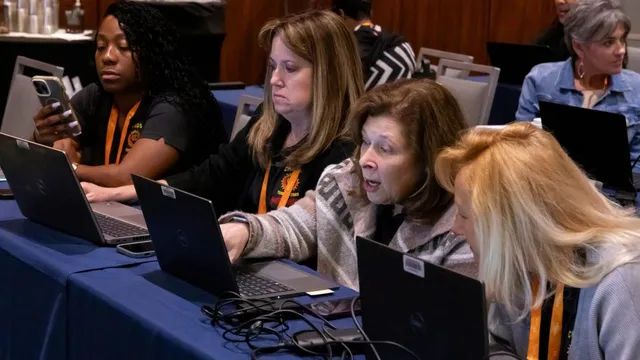
In recent discussions surrounding the impact of artificial intelligence on administrative roles, a notable trend has emerged highlighting the evolving nature of executive assistants. The administrative profession, which is predominantly female, faces potential job displacement due to AI advancements. However, many professionals in this field are adapting by integrating AI into their daily tasks. Deanna Danger, an administrative professional since 2003, emphasizes the importance of evolving with technology, showcasing how tools like AI can enhance productivity rather than replace jobs. This sentiment is echoed by Fiona Young, who has observed a significant increase in demand for training executive assistants on effective AI usage since 2023. Young notes that employers are looking for staff who can leverage AI as a core component of their work processes. Oana Manolache, CEO of Sequel.io, has taken a strong stance on AI adoption, stating she would terminate employees who do not utilize AI. Despite this, she acknowledges that AI cannot replace the nuanced and human-centric tasks performed by her executive assistant, Stephanie Martinez. Martinez effectively uses AI to streamline her workload, allowing her to focus on more strategic responsibilities that require human judgment and interpersonal skills. This shift in the role of executive assistants is further illustrated by the innovative approaches taken by Martinez, who has successfully tackled challenges such as increasing customer reviews through creative problem-solving. The landscape for administrative professionals is changing, with many embracing AI as a tool for empowerment rather than a threat to their jobs. As the demand for skilled administrative support continues to grow, the ability to adapt and leverage technology will be crucial for success in this evolving field.