

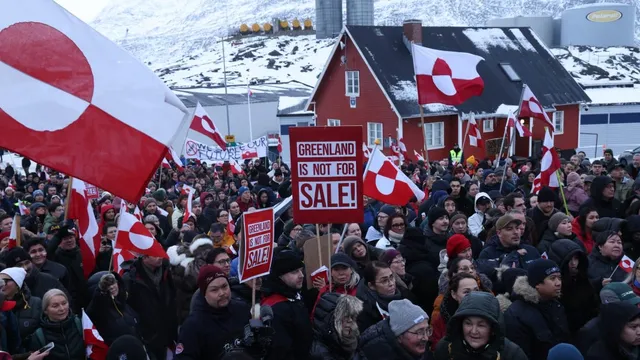
Trump demands U.S. military presence in Greenland amid Arctic tensions
Trump demands U.S. military presence in Greenland amid Arctic tensions
- Diplomatic talks began on January 28, 2026, involving the United States, Greenland, and Denmark to resolve tensions over Greenland.
- The discussions follow Trump's controversial calls for U.S. control of the territory, citing national security threats from Russia and China.
- The outcome of these talks will significantly impact U.S.-Danish relations as they address security concerns in the Arctic.
Story
In Greenland, diplomatic talks began on January 28, 2026, between the United States, Greenland, and Denmark to address escalating tensions related to President Donald Trump's comments regarding the Arctic territory. These discussions follow months of strained relations between Denmark and the U.S., particularly concerning Trump's declaration that he wanted to acquire Greenland, citing national security threats posed by Russia and China. Danish officials expressed strong resistance to the notion of selling Greenland, asserting the territory is not for sale and emphasizing their national sovereignty. The U.S. Secretary of State Marco Rubio conveyed that a structured process regarding Greenland now exists, with technical meetings planned to negotiate the security concerns raised by the U.S. administration, while respecting Denmark's established boundaries on the matter. Trump's insistence on U.S. control over the region has sparked significant apprehension among NATO allies and created a rift that threatens to influence transatlantic relations. Greenland is strategically important due to its natural resources and military positioning amidst the rapidly changing dynamics of Arctic governance. The Arctic region is becoming increasingly relevant as climate change leads to the melting of ice, exposing vast resources and new shipping routes. This situation has further intensified the U.S. stance on protecting its interests against perceived threats from competing nations, particularly in light of Russia's extensive military activities in the Arctic and China's growing economic presence. There is a palpable tension between U.S. aspirations for greater access to Greenland's resources and Denmark's commitment to maintaining its autonomy. EU officials have also downplayed any significant foreign threats to Greenland, dismissing claims of imminent invasions and arguing that collaborative NATO security efforts should address any concerns over Arctic defense. The outcome of these diplomatic talks remains critical for future U.S.-Danish relations, as both parties navigate the complexities of security and territorial integrity in this strategically important region.
Context
The diplomatic relations between the United States, Greenland, and Denmark have a complex historical backdrop that reflects both strategic interests and cultural ties. Greenland, an autonomous territory within the Kingdom of Denmark, has been a focal point for American interests due to its strategic location in the North Atlantic. The relationship can be traced back to the early 20th century when the United States sought to solidify its presence in the Arctic and counteract European influence. The purchase of the Danish West Indies in 1917 further highlighted American ambitions in the region, laying the groundwork for ongoing interactions with Greenland and Denmark. During World War II, the dynamics intensified as the U.S. established air bases in Greenland to support operations against Axis powers. This military presence cemented a partnership that continued throughout the Cold War, with Greenland's Thule Air Base serving as a key strategic asset for U.S. military operations. The United States and Denmark formalized their relationship through various agreements, most notably the 1951 Defense Agreement, which allowed the U.S. to maintain military facilities in Greenland in exchange for financial support and infrastructure development. This agreement underscored the importance of Greenland in the context of global security and U.S. military strategy. In recent years, the relationship has adapted to new geopolitical realities, particularly with the increasing significance of the Arctic region due to climate change and melting ice caps. The United States has expressed renewed interest in Greenland as an area for potential resource extraction and scientific research. Initial discussions about purchasing Greenland in 2019 highlighted the U.S. interest, although the idea was met with resistance from both the Danish government and the Greenlandic population. Denmark's commitment to Greenland's autonomy and local governance underscores a delicate balance in the relationship, emphasizing respect for Greenland's self-determination while still highlighting U.S. strategic interests in the region. The diplomatic relations among these entities are evolving as global priorities shift. As concerns about environmental issues, indigenous rights, and economic development rise, the United States and Denmark are working to navigate these complexities collaboratively. Joint ventures in scientific research, climate change initiatives, and economic development projects have emerged as focal points for bilateral cooperation. Looking ahead, it is crucial for all involved parties to continue fostering their relationships by respecting Greenland's autonomy while recognizing its strategic importance amidst the changing dynamics of international politics.


