

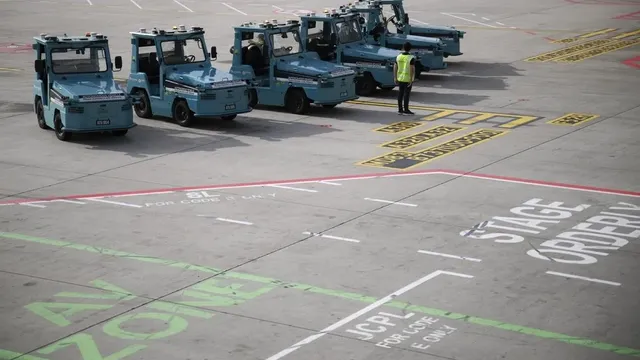
Changi Airport implements driverless tractors for baggage transport
Changi Airport implements driverless tractors for baggage transport
- Changi Airport officially launched autonomous baggage tractors on January 20, 2026.
- These tractors are capable of towing up to 25 tonnes of baggage over a 7km route between terminals.
- The introduction of these AVs marks a significant advance in airport operations, allowing workers to focus on more complex tasks.
Story
On January 20, 2026, Changi Airport in Singapore commenced the operational use of autonomous vehicles (AVs) designed as driverless tractors for baggage transportation between terminals 1 and 4. The fully autonomous tractors have undergone extensive testing since November 2024, performing over 5,000 test trips with a safety driver on board until November 2025. These tractors can tow a total of 25 tonnes of baggage and operate along a 7km route linking the airport's oldest and newest terminals. This initiative is significant as the existing baggage-handling systems at T4 and the other terminals are disconnected, requiring transport solutions for efficient baggage transfer. The introduction of these AVs is a strategic advancement for Changi Airport, allowing employees to focus on higher-skilled tasks that demand decision-making abilities and experience. Currently, the airport employs around 600 traditional tractors, and it is projected that by 2027, there will be a fleet of 24 autonomous tractors operating airside. Liu Yanling, CAG's senior vice-president of airport operations strategy and transformation, highlighted that the removal of driving roles will enhance the overall efficiency of operations. She emphasized that the AVs are equipped to navigate obstacles and stop if any deviation from the set path is detected, ensuring safety and reliability during operations. Prior to this deployment of autonomous tractors, Changi Airport had tested various AVs, including a self-driving bus for transporting workers. The airport also trialed autonomous baggage-handling vehicles capable of loading and unloading baggage containers. These previous trials contributed to the advancements seen today, showcasing Changi Airport's commitment to integrating innovative technologies to optimize airside operations and enhance passenger services. Overall, the deployment of driverless baggage tractors represents a transformative step in airport operations. It not only marks the airport’s technological progress but also sets a precedent for the implementation of autonomous systems within the aviation industry, paving the way for similar innovations in other international airports across the globe.
Context
The logistics of airport operations are undergoing a significant transformation due to the emergence of future technologies. Various innovations are being implemented to streamline processes, enhance operational efficiency, and improve passenger experiences. Technologies such as automation, the Internet of Things (IoT), artificial intelligence (AI), and blockchain have become essential in reshaping the landscape of airport logistics. These advancements support critical functions such as baggage handling, security, and resource management, ultimately aiming to reduce delays and improve turnaround times for flights. Automation plays a pivotal role in revolutionizing airport logistics by minimizing human involvement and accelerating routine tasks. Automated baggage handling systems, equipped with advanced sorting and tracking capabilities, ensure that luggage is efficiently processed from check-in to loading onto the aircraft. Additionally, automated passenger management systems facilitate smoother check-in procedures and boarding processes, requiring less manual intervention and thereby decreasing waiting times and improving passenger satisfaction. These systems utilize AI to adapt to changing circumstances and improve their efficiency continuously. The Internet of Things (IoT) is another vital technology contributing to enhanced airport logistics. By embedding smart sensors and devices throughout airport facilities, stakeholders are enabled to collect and analyze vast amounts of data concerning passenger flows, baggage movements, and equipment status. This real-time data empowers airport management teams to make informed decisions, optimize resource allocation, and enhance safety protocols. Moreover, IoT technology fosters communication between different airport systems, thereby facilitating a seamless operational ecosystem that can respond rapidly to fluctuating demands. Blockchain technology offers airport logistics a secure and transparent framework for managing the extensive amount of information exchanged among various stakeholders. By utilizing a decentralized ledger system, airports can ensure data accuracy, secure transactions, and passenger privacy. This technology is particularly beneficial in tracking cargo shipments, which can enhance supply chain visibility and reduce instances of fraud or lost items. Furthermore, blockchain can play a significant role in fostering seamless collaboration among airlines, ground handlers, and security agencies, leading to a more synchronized and efficient airport operation.


