

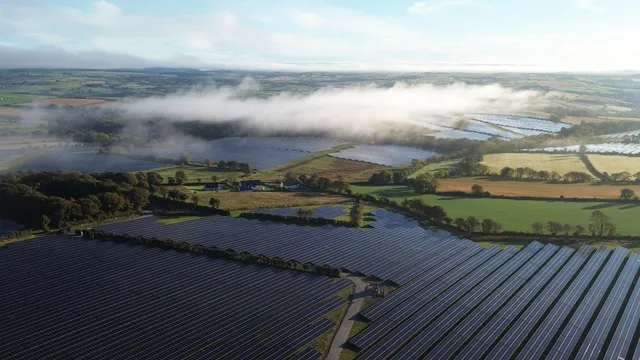
European Investment Bank invests €260 million in Irish solar projects
European Investment Bank invests €260 million in Irish solar projects
- The European Investment Bank is investing €260 million in four solar photovoltaic projects across Ireland.
- These projects are expected to generate approximately 367 GWh of clean electricity annually.
- This investment will significantly advance Ireland's renewable energy goals and create new job opportunities.
Story
In March 2026, the European Investment Bank (EIB) announced a significant investment in renewable energy projects across Ireland. This investment, totaling €260 million, aims to support the construction and operation of four large utility-scale solar photovoltaic (PV) projects located in Clare, Wicklow, Wexford, and Tipperary. The commitment includes a €100 million project finance loan directed towards Dolmen Solar Ltd, which is affiliated with Power Capital Renewable Energy. Collectively, these initiatives are expected to produce approximately 367 GWh of clean electricity annually, which corresponds to the energy consumption of about 79,900 households. The investment marks one of the largest solar financing efforts to date in Ireland, contributing to the country’s goal of achieving 80% renewable electricity by 2030. Specific projects will see construction starting in March 2026, including the 15.5 MWp Ballinaclough Solar Farm in Wicklow, the 181.6 MWp Tullabeg Solar Farm in Wexford, the 98 MWp Barnaleen Cauteen Solar Farm in Tipperary, and the 99.5 MWp Manusmore Solar Farm near Ennis in Clare. Some work on these projects could extend into 2028, emphasizing the long-term nature of renewable energy development in the region. Ireland’s Minister for Climate, Energy and the Environment, Darragh O’Brien TD, remarked on the changing perception of solar energy in the nation, pointing out strong investor interest in renewables. The EIB's vice-president Ioannis Tsakiris highlighted that this investment helps unlock nearly 400 MW of new renewable capacity, which will improve Ireland’s energy security and help reduce greenhouse gas emissions. Furthermore, the funding is expected to generate employment opportunities in sectors related to construction, civil works, grid connections, and maintenance services. Amid these developments, another renewable energy company based in Carlow, SunArc, announced plans to create 50 new jobs backed by a separate €20 million investment. This company's 'solar-as-a-service' model aims to accelerate Ireland’s transition to clean energy by allowing businesses to access solar power without incurring upfront costs. Overall, these movements reinforce Ireland’s increasing commitment to renewable energy and its ambitions to enhance energy independence and sustainability for the future.
Context
The Irish renewable energy sector has been gaining momentum in recent years, driven by a combination of government policy, advancements in technology, and increasing public awareness of climate change. Ireland has set ambitious targets for reducing greenhouse gas emissions and increasing the share of renewable energy in its overall energy mix. By 2030, the government aims to source 70% of its electricity from renewable sources, with a strong emphasis on wind and solar energy. This commitment not only reflects Ireland's obligations under international climate agreements but also presents an opportunity to enhance energy security and create economic growth through the development of the green technology sector. Wind energy has emerged as a dominant force in Ireland's renewable energy landscape. The country boasts some of the best wind resources in Europe, with both onshore and offshore wind projects being developed at an unprecedented rate. Offshore wind farms, in particular, represent a vast opportunity for expansion, with projects like the Celtic Sea and the North Irish Sea aiming to harness wind speeds that can generate substantial amounts of clean electricity. By leveraging advancements in turbine technology and marine engineering, these projects are positioned to provide a significant contribution to the national grid, while also supporting local job creation in construction and maintenance roles. Solar energy is another critical component of Ireland's renewable energy strategy. Although solar generation currently accounts for a smaller percentage of total electricity production compared to wind, the installation of solar photovoltaic systems has been increasing steadily. Government incentives and the introduction of supportive legislation have made solar energy more accessible for homeowners and businesses alike. As awareness grows about the benefits of solar technology, including lower energy bills and enhanced energy independence, it is expected that adoption rates will rise significantly in the coming years. In addition to these primary sources of renewable energy, Ireland is investing in energy storage solutions and grid enhancement measures to improve the reliability and efficiency of its energy system. The intermittent nature of wind and solar power necessitates robust energy storage systems that can balance supply and demand effectively. Initiatives to upgrade the electrical grid are also crucial, ensuring that energy generated from renewable sources can be efficiently transmitted to consumers. Overall, the future of Irish renewable energy projects looks promising, with ongoing innovation, strategic investment, and a strong policy framework set to position Ireland as a leader in the global green energy transition.


