

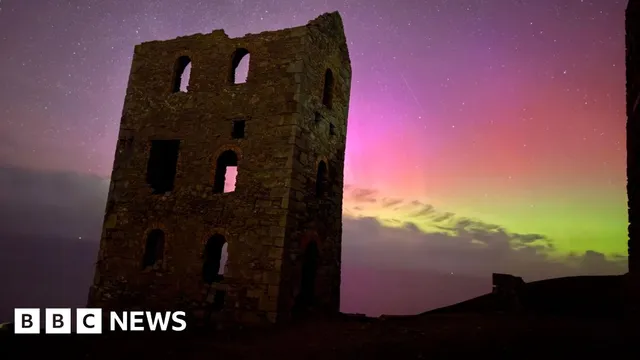
Severe solar storm allows Northern Lights to reach UK skies
Severe solar storm allows Northern Lights to reach UK skies
- An extreme space weather alert from the Met Office indicates strong geomagnetic storms could allow for aurora visibility in the UK.
- The solar activity was caused by a significant solar flare and coronal mass ejection that occurred on January 18.
- If conditions are favorable, the Northern Lights may be seen in the UK, although cloud cover could complicate viewing.
Story
On January 18, 2026, a colossal solar flare was launched, which resulted in a coronal mass ejection expecting to reach Earth between late January 19 and early January 20. This phenomenon prompted the Met Office in the United Kingdom to issue an extreme space weather alert due to the potential for strong auroras to be visible across the country. Colloquially known as the Northern Lights, the auroras can be seen typically in polar regions, but under certain conditions, they can extend further south. Due to heightened solar activity and geomagnetic storms, the auroras offered a rare chance for visibility at mid-latitudes, including the UK. Meteorologist Krista Hammond indicated that while the uniqueness of the event increased the odds of witnessing the auroras, cloudy conditions could hinder viewing experiences. A brief break from cloud cover may also occur in some areas, posing a mix of opportunity and uncertainty for potential viewers. Furthermore, the best time to observe these lights is typically within the hour or two of midnight, although visibility may fluctuate as geomagnetic activity changes throughout the evening and morning. On January 19, the skies over parts of the UK indeed lit up with mesmerizing displays of green and red, creating a stunning visual experience for many. However, challenges remained regarding the clarity of the sky, especially on January 20, when cloud and rain might obscure the view, despite optimal conditions. The potential viewing of auroras during this time has excited the public and highlighted the unpredictable nature of space weather impacts on Earth's atmosphere.
Context
Geomagnetic storms are disturbances in the Earth's magnetosphere caused by solar wind and solar flares. These storms occur when the interplanetary magnetic field (IMF) becomes southward oriented, allowing solar wind particles to enter the Earth's magnetic shield more effectively. As the solar wind interacts with the Earth's magnetic field, it can result in significant changes to the magnetosphere, thus giving rise to geomagnetic storms. The magnitude and effects of these storms can vary widely, depending largely on the speed and density of the solar wind as well as the strength of the IMF. The effects of geomagnetic storms can be both intriguing and concerning. One of the most visible and beautiful impacts of these storms is the auroras, also known as the Northern and Southern Lights, which occur when charged particles collide with atmospheric gases near the poles, creating vibrant displays of light. However, geomagnetic storms can also have serious implications for modern technology and infrastructure. For instance, they can disrupt satellite operations, leading to communication and navigation errors, and can even damage satellite electronics due to increased radiation exposure. Moreover, geomagnetic storms can affect power grids by inducing currents that can cause transformer damage and widespread power outages. In addition to satellite and power grid impacts, geomagnetic storms pose risks to aviation and maritime navigation, particularly for flights that traverse polar regions where the radiation exposure is heightened. Airlines may reroute flights to avoid increased radiation levels, and the increased drag on satellites can alter their orbits, necessitating adjustments. The potential for disruptions and damages has led to increased monitoring and forecasting of geomagnetic storms, enabling better preparation and mitigation strategies for industries that rely heavily on technology. As we continue to advance our reliance on technology, understanding geomagnetic storms and their effects is crucial. Increased solar activity is anticipated as we approach the solar maximum, which can compound the effects of geomagnetic storms. Researchers are focusing on improved forecasting techniques, modeling, and real-time monitoring to prepare for potential impacts on infrastructure and assets. Due to their extensive and varied consequences, geomagnetic storms remain a significant area of investigation, underscoring the need for a robust understanding of solar-terrestrial interactions.


