

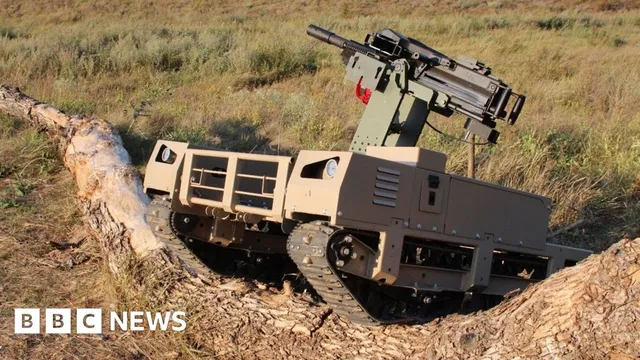
Ukraine deploys armed robots against Russian forces
Ukraine deploys armed robots against Russian forces
- Ukraine has initiated a program to field armed robots against Russian troops in the ongoing conflict.
- These robots are equipped with weaponry and can carry out missions with varying degrees of autonomy.
- The integration of UGVs represents a transformative shift in military tactics, emphasizing the need for technology in supporting human soldiers.
Story
In recent military advancements, Ukraine has significantly innovated its battlefield capabilities through the deployment of armed robots. These unmanned ground vehicles (UGVs) are now actively being used against Russian forces amid the ongoing conflict that escalated years ago. Ukrainian forces have utilized these machines for various tactical advantages, including ambushing enemy personnel carriers. The mechanization of warfare with robots is a major shift, allowing Ukrainian soldiers to minimize their exposure to danger while maintaining strategic operations. The innovations in military technology come at a crucial time, as infantry soldiers require support alongside uncrewed systems. Major Oleksandr Afanasiev from the Ukrainian army's K2 brigade emphasizes the necessity of UGVs, stating that while robots can be lost in action, the preservation of battle-ready soldiers is paramount. This statement reflects a broader military doctrine emphasizing technology as a supplement to human troops rather than a total replacement. Robots in Ukraine's arsenal can carry weaponry such as Kalashnikov machine guns and grenade launchers, capable of conducting various offensive and defensive operations autonomously to an extent. Their development marks a new chapter in modern warfare, contrasting with the traditional battlefield engagements involving human soldiers. As these systems evolve, the potential for increased clashes between Ukrainian and Russian UGVs grows, heralding a concerning future of automated warfare. As Ukrainian manufacturers ramp up production, the implications of deploying these robots extend beyond immediate combat advantages. Companies like Devdroid have produced hundreds of strike droids, aiming for future advancements that would allow autonomous operations, returning to base after missions. The rapid increase in these technologies could lead to more complex engagements on the battlefield, necessitating further strategic planning and adjustments from military leaders on both sides of the conflict. The emergence of active robot engagements between Ukraine and Russia reflects a crucial juncture in military strategies in this ongoing war, underscoring the necessity to adapt to technological evolution in warfare.
Context
Unmanned Ground Vehicles (UGVs) have become an integral component of modern warfare, significantly transforming military operations. They serve various roles, ranging from logistics and reconnaissance to direct combat and support tasks. UGVs enhance operational effectiveness by enabling forces to conduct missions with reduced risk to human life, particularly in hazardous environments. Their ability to navigate rough terrains and access areas that are difficult for manned vehicles further underscores their strategic value on the battlefield. As technology advances, UGVs are increasingly equipped with sophisticated sensors, weaponry, and autonomous navigation systems that allow for greater operational versatility and efficiency. The role of UGVs extends to intelligence, surveillance, and reconnaissance (ISR) operations, where they can gather critical data without exposing personnel to enemy fire. Equipped with high-resolution cameras and advanced sensing technologies, UGVs can provide real-time situational awareness, helping commanders make informed decisions. Furthermore, UGVs can operate in environments that are too dangerous for troops, such as minefields or areas with chemical exposure, thereby allowing military forces to assess and respond to threats more effectively. Their use in ISR not only enhances tactical operations but also contributes to strategic advantage in broader military campaigns. In addition to reconnaissance, UGVs play a crucial role in logistical operations, transporting supplies, equipment, and even medical aid to troops in remote or hostile locations. This capability is vital for maintaining supply lines and ensuring that troops are well-equipped and supported during missions. Automated resupply missions can free up personnel for other essential tasks, increasing overall efficiency. Furthermore, UGVs can assist in explosive ordnance disposal (EOD) missions, allowing for the safe identification and neutralization of explosives without placing human lives at risk. The ability to deploy UGVs for logistical and support operations reinforces the military's operational capabilities. As warfare continues to evolve, the integration of UGVs into military strategies is expected to grow. Their deployment raises new considerations regarding tactics, training, and ethical implications. While UGVs offer substantial benefits in terms of mission efficiency and risk reduction, the reliance on autonomous systems also prompts discussions on accountability and decision-making in combat. Overall, UGVs represent a significant advancement in modern military capabilities, providing many advantages that enhance operational effectiveness while minimizing risks to personnel.


