

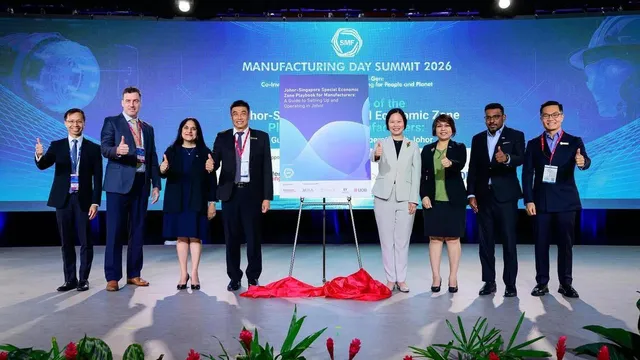
Singapore manufacturers gain guidance for expansion in Johor
Singapore manufacturers gain guidance for expansion in Johor
- A playbook for manufacturers was launched to facilitate operations in the Johor-Singapore Special Economic Zone.
- Regional collaboration is prioritized due to ongoing supply chain issues and geopolitical tensions.
- The initiative aims to boost confidence and streamline the expansion of Singapore manufacturers into Malaysia.
Story
Singapore has recently seen significant strides in enhancing regional partnerships aimed at boosting its manufacturing sector. On January 30, 2026, the Singapore Manufacturing Federation (SMF) announced a new playbook tailored to assist manufacturers wishing to establish operations within the Johor-Singapore Special Economic Zone (JS-SEZ). The initiative reflects increasing collaboration among regional partners in light of various contemporary challenges such as supply chain vulnerabilities and geopolitical tensions. The Manufacturing Day Summit 2026 was marked by the signing of eight agreements, including a key partnership with the Industrial Estate Association of Indonesia. As Minister of State for Trade and Industry Gan Siow Huang emphasized, the need for strong regional affiliations is crucial for unlocking growth opportunities while building resilience against external pressures. Singapore's historical connections with areas like Batam, Bintan, and Karimun in Indonesia—as well as Johor in Malaysia—present viable prospects for companies looking to anchor their operations in Southeast Asia. The playbook, created with contributions from entities like Enterprise Singapore and the Malaysian Investment Development Authority, aims to provide businesses with essential information about regulations, talent mobility, and infrastructure while fostering a greater understanding of the market dynamics across both Singapore and Malaysia. In further efforts to support manufacturers, SMF has facilitated site visits to Johor, thereby empowering companies to make informed decisions regarding their expansion plans. For instance, Lim Yeong Chuan, the director of a metal casting and forging specialist, articulated that the decision to explore factory establishment in the JS-SEZ emerged from growing customer demands for extensive product support. With Malaysia offering accessible land for manufacturing and proximity to Singapore, the company is now advancing towards finalizing its factory by the end of 2026. Lim highlighted the importance of understanding the Malaysian tax system for factories and expressed appreciation for the guidance provided by SMF in locating potential partners in Johor. The ambitious JS-SEZ encompasses an area of 3,500 sq km, significantly larger than Singapore’s size, extending beyond Johor Bahru and incorporating vital business hubs like Iskandar Malaysia. The establishment of the playbook and associated support mechanisms signifies a broader commitment by the Singapore government and associated bodies to adapt to evolving economic landscapes while also focusing on sustainable development and talent nurturing amidst technological advances in AI, robotics, and digitalization. This coordinated response to both local and regional economic needs serves to position Singapore as a robust player in Southeast Asian manufacturing, demonstrating a forward-thinking approach to economic planning and collaboration.


