

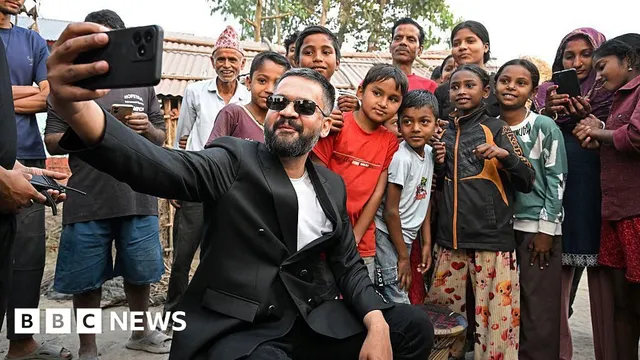
Rapper Balen takes charge as Nepal's new prime minister
Rapper Balen takes charge as Nepal's new prime minister
- Balendra Shah, previously the mayor of Kathmandu, won the prime ministerial election after his party commanded a majority in parliament.
- His election follows youth-led protests demanding change, showing a collective discontent with corruption and nepotism in Nepal.
- Shah's rise to power signifies a shift towards a new political direction in Nepal as expectations mount for improved governance and transparency.
Story
Nepal has marked a significant turning point in its political landscape with the swearing-in of Balendra Shah, a rapper turned politician, as its new prime minister. This event took place on March 5, 2026, following a successful electoral campaign that saw Shah's party, the Rastriya Swatantra Party (RSP), winning a majority in the parliament. His election came at a time when the country was still coping with the aftermath of youth-led protests that led to substantial political upheaval and demands for improved governance and transparency. Balendra Shah, who previously served as the mayor of Kathmandu, has a history of advocating against corruption through his music, which resonated with a frustrated electorate. His songs addressing social issues and corruption played a key role in rallying support from the youth and first-time voters. During his brief tenure as mayor, he focused on urban issues but faced criticism for his handling of street vendors and for certain controversial social media posts. The context of Shah's election is crucial; the country has been plagued by political instability, having seen a large number of governments failing to complete full terms. His victory is viewed as a potential break from the established political norms and signals hope for a new generation eager for reforms. As the youngest prime minister in decades and the first from the Madhesi community, there is an expectation for Shah to prioritize issues such as job creation and addressing corruption while restoring faith in government institutions. However, challenges loom as he is tasked with negotiating both the expectations of the electorate and the political dynamics that have historically led to turbulence in Nepal's governance. The opposition parties' responses and the effectiveness of the RSP in implementing the promised changes will likely determine whether Shah can navigate these challenges and effect real change in the lives of Nepali citizens.


