

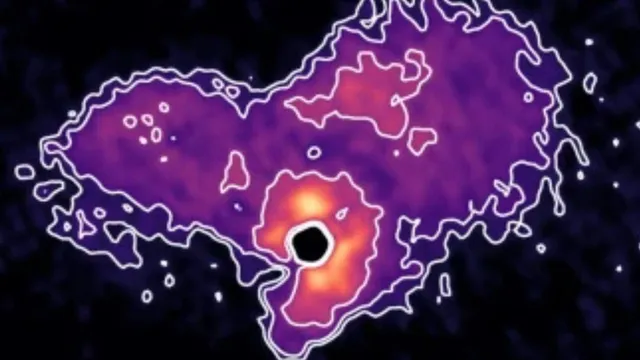
Star surprises astronomers with heart-shaped cloud ahead of Valentine’s Day
Star surprises astronomers with heart-shaped cloud ahead of Valentine’s Day
- Astronomers detecting a heart-shaped cloud of dust and gas from the red giant star Mira A at a distance of 300 light-years.
- The key observation reveals an unexpectedly large volume of material being released, with a mass equivalent to seven times that of Earth.
- These findings provide insights into stellar evolution and emphasize the interconnected dynamics within binary star systems.
Story
In the vicinity of 300 light-years from Earth, a large cloud of dust and gas shaped like a heart has been observed emanating from the red giant star Mira A. Astronomers have been monitoring this star, which has been a subject of interest for more than 400 years, particularly due to its variability in brightness. The recent observations were primarily conducted using advanced telescopes located in Chile, such as the Very Large Telescope and the Atacama Large Millimeter/submillimeter Array, which allowed researchers to track the developments from 2015 to 2023. This study has revealed that the ejected material encompasses a staggering volume—about 100 times more than previously anticipated and equivalent to seven times the mass of Earth. The dynamics surrounding Mira A are complex, as it is part of a binary star system with its companion, a white dwarf named Mira B. Researchers have identified that the star behaves like a lighthouse in its illumination of the surrounding dust, casting uneven light due to its pulsating surface. These new findings led to a better understanding of how aging stars like Mira A lose mass over time, which can result in significant bursts, contributing fresh insights into stellar evolution. Scientists emphasized the importance of continued monitoring of Mira A's expanding cloud, as it could dramatically impact Mira B by potentially gathering the ejected material from its companion. Interestingly, the phenomenon unveiling around Mira A serves as a perfect analogy for the romantic undertones often celebrated during Valentine’s Day, symbolizing how even in the vast cosmos, there are elements that mimic human experiences of love and beauty. The case of Mira A is not only a significant scientific discovery but also a poetic reminder of the connections that can be drawn between the stars and the themes of love, reaffirming the idea that science and romance can indeed coexist. As the astronomical community continues its exploration and monitoring of Mira A, there lies an anticipation for more discoveries that may unfold, revealing the intricate processes at work in our universe and how they contribute to the genesis of new star systems. Each finding aids in the broader understanding of the lifecycle of stars, inviting questions about the fate of stars as they age and the role they play in the cosmic landscape, thus providing an evolving narrative on the natural processes of stellar evolution.


