

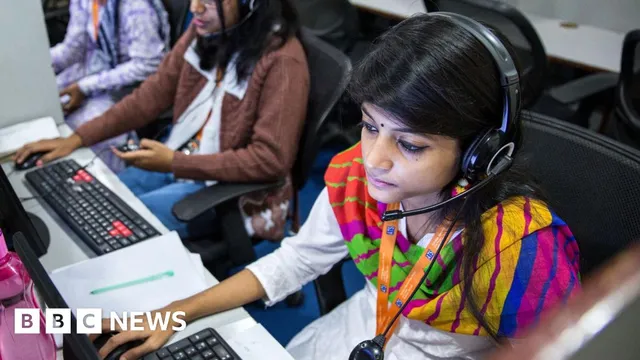
Indian IT stocks decline sharply amid AI disruption fears
Indian IT stocks decline sharply amid AI disruption fears
- Indian technology stocks have faced a sharp decline due to concerns over AI disrupting traditional outsourcing models.
- Recent developments in AI tools have prompted fears of significant job losses within the sector.
- The Indian IT industry's future hinges on evolving with AI, presenting both challenges and potential opportunities.
Story
Over the past few weeks, the Indian technology sector has experienced a severe downturn, primarily due to concerns surrounding the impact of artificial intelligence on the traditional outsourcing model. This downturn is significant for India, where the IT industry plays a crucial role in creating millions of jobs and has contributed to the rise of a new middle class. The market's reaction is part of a broader global correction affecting software and IT companies, specifically highlighted by a notable 20% decline in the Nifty IT index this year, resulting in a loss of tens of billions in investments. The panic within the industry escalated after Anthropic's release of a new AI tool that threatened to automate vital legal, compliance, and data processes, core functions that traditionally relied heavily on human labor. Concerns were further magnified as industry leaders and analysts predicted that as much as 50% of entry-level white-collar jobs could be eliminated by AI by 2030, casting a shadow over the long-established labor-centric model of the outsourcing sector. Experts from Jefferies and other financial institutions forecast that this transformation could lead to significantly lower revenue growth trajectories for IT firms. JPMorgan highlighted that while AI will facilitate more complex tasks and software coding, it cannot fully replace the customization and tailored approaches that dedicated software companies provide. Compounding these challenges is a shift in billing practices, moving away from traditional hourly rates to more outcome-based pricing models. Although the industry is beginning to acknowledge these shifts, immediate revenue from AI initiatives remains minimal compared to the overall revenue generated. Despite these alarming trends, there is a belief among industry insiders that AI may also impart new opportunities in the long term. However, the transition will not be easy, and growing restrictions around U.S. work visas add to the severe challenges faced by this vital sector, which accounts for approximately 80% of India's total services exports. Analysts suggest that the full effects of AI adoption, both positive and negative, may only manifest in the medium term, making the current landscape fraught with uncertainty for India's IT sector and its workforce.


