
military conflicts
tragic
impactful

Parents remember Cody Khork after he is killed in Iranian drone strike

Mar 9, 2026, 11:13 AM10
(Update: Mar 9, 2026, 11:13 AM)
land service branch of the United States Armed Forces
president of the United States from 2017 to 2021
sovereign state in Western Asia

Parents remember Cody Khork after he is killed in Iranian drone strike

  • On March 1, 2020, six U.S. service members, including Army Reserve Captain Cody Khork, were killed in a retaliatory drone strike in Kuwait.
  • The attack was part of Iran's response to joint U.S.-Israeli airstrikes that triggered Operation Epic Fury.
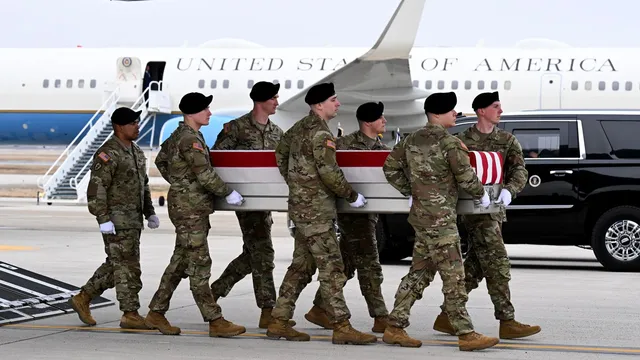
  • Cody Khork's parents remembered him as a natural-born leader with a 'giving soul' at the dignified transfer ceremony attended by President Trump.
Share your opinion
1

Story

On March 1, 2020, during a retaliatory strike by Iran, Army Reserve Captain Cody Khork was tragically killed along with five other U.S. service members in Kuwait. This incident was part of Iran's response to U.S.-Israeli airstrikes, which had initiated Operation Epic Fury. The attack marked a significant escalation in tensions between the U.S. and Iran, highlighting ongoing conflicts in the Middle Eastern region. The dignified transfer of their remains witnessed the attendance of President Donald Trump and First Lady Melania Trump, who expressed condolences to the grieving families. Cody Khork's parents described their son, whom they regarded as a natural leader, with a "giving soul." James Khork, his father, shared how his son had the ability to unite people from different backgrounds, demonstrating leadership qualities throughout his life. This characterization offered insight into how profound the loss was for his family and community. At the same transfer ceremony, Stacey Khork, his stepmother, reflected on the emotional toll that the event took on their family but felt proud to honor her son in a dignified manner. The loss of Cody Khork came amidst escalating violence and increasing military actions in the region, which also raised concerns about potential further military engagements and the risks faced by service members. Experts warned that more casualties could be expected as the situation developed under Operation Epic Fury, emphasizing the volatile nature of military campaigns and international relations in the Middle East. Cody's parents recalled their encounter with the President and First Lady, who they described as respectful and approachable. This meeting offered a personal connection amid the public ceremonies, emphasizing that the sacrifices made by service members impact many lives beyond the battlefield. The ceremony itself served not only as a means of honoring the fallen but also highlighted the stark realities of warfare and the personal toll it takes on families, as well as the pride and grief intertwined in such a loss.

Context

The impact of U.S.-Iran relations on military operations has historically been profound and continues to evolve in the context of geopolitical changes and regional dynamics. Since the Islamic Revolution in 1979, U.S.-Iran relations have been characterized by hostility, sanctions, and intermittent negotiations. The complexities of these relations significantly affect military operations in the Middle East, particularly in areas such as Iraq, Syria, and the Persian Gulf. U.S. military strategy has often aimed to counter Iranian influence, which is perceived as destabilizing by American policymakers. This influence manifests through proxy groups and alliances, necessitating a recalibration of U.S. military presence and operations in the region. The contentious nature of U.S.-Iran relations not only shapes the operational strategies of the U.S. Armed Forces but also influences allied nations and local military actors. U.S. military operations must account for the potential for Iranian retaliation or disruption, particularly through asymmetric warfare tactics employed by Iranian proxies. This dynamic has led to an increased emphasis on intelligence-gathering, counterinsurgency operations, and the preparation for potential confrontations with Iranian forces or allied militias. The complexities of these relationships complicate strategic planning, as the U.S. must balance the need to contain Iran's reach while avoiding escalation into a broader conflict. Moreover, the nuclear negotiations surrounding Iran's nuclear program have added another layer to military operational considerations. Periodic negotiations and agreements, such as the Joint Comprehensive Plan of Action (JCPOA), while aimed at curbing Iran's nuclear capabilities, have had ripple effects on military strategy. The potential lifting or reinstatement of sanctions influences Iranian military budgets and capabilities, which in turn affects U.S. planning and operational readiness. As Iran advances its military technologies and develops its missile capabilities, U.S. forces must constantly adapt to technological developments that could threaten regional allies and American interests. In conclusion, the ongoing tensions and evolving nature of U.S.-Iran relations fundamentally shape military operations within the region. The United States is compelled to navigate a complex landscape of threats, alliances, and diplomatic engagements, all while maintaining a credible military posture. Understanding the implications of these relations is critical for effective military planning and execution, requiring continuous assessment of both regional dynamics and global geopolitical shifts that influence the operational environment.

2026 All rights reserved
