

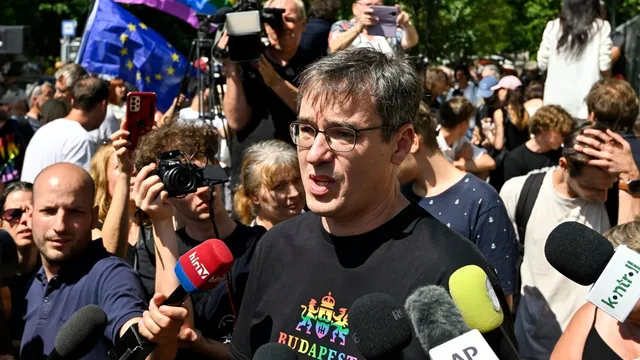
Budapest mayor faces charges for defying ban on pride event
Budapest mayor faces charges for defying ban on pride event
- Gergely Karacsony has been charged for organizing a banned LGBTQ+ Pride event in Budapest last year.
- The march occurred in June 2025, despite a police ban, and attracted 300,000 participants.
- Karacsony asserts he will not be deterred from advocating for freedom and LGBTQ+ rights.
Story
In Hungary, authorities have charged Gergely Karacsony, the mayor of Budapest, due to his involvement in organizing an LGBTQ+ Pride event that was prohibited by the government's ban. The march, which took place on June 28 of last year, attracted approximately 300,000 participants, making it the largest Pride event in the nation's history. Following the event, Karacsony faced a police investigation, ultimately resulting in formal charges from the Budapest Chief Prosecutor's Office. Prosecutors are seeking a fine against him for organizing an unlawful assembly despite the ban. The charges stem from a contentious atmosphere surrounding LGBTQ+ rights in Hungary, particularly following the adoption of new laws that restrict public events related to LGBTQ+ themes under the justification of protecting minors. Karacsony urged citizens to defy the police's declaration that the Pride event was illegal and publicly encouraged its participation via statements and videos. His resistance comes amid a broader governmental push guided by Prime Minister Viktor Orbán, whose administration has faced criticism for legislation perceived as discriminatory against LGBTQ+ communities. As the legal proceedings against him unfold, Karacsony has characterized his role in the event as one of courage, emphasizing that standing up for freedom should not be criminalized. He made it clear that he will not be intimidated or deterred from advocating for LGBTQ+ rights, framing the government's actions as an infringement on democratic values. The climate in Hungary around LGBTQ+ rights has been increasingly controversial, with conflicting ideologies between progressive and traditional values leading to rising tensions regarding social issues. Karacsony, who has held the mayor's office since 2019, was recently honored with the Dutch Geuzenpenning Award, recognizing his commitment to democratic principles and advocacy for LGBTQ+ rights. This accolade highlights the international support for his cause and stands in stark contrast to the Hungarian government’s stance, which has been labeled as regressive and out of alignment with European Union values. The outcome of this situation may influence not only the political landscape in Hungary but also the country's position regarding LGBTQ+ rights on a broader European stage.
Context
Hungary has witnessed significant changes in its legislative landscape regarding LGBTQ rights, particularly related to pride events, as of 2026. Over the past few years, there has been an ongoing discourse surrounding the protection and rights of LGBTQ individuals in Hungary. The government has implemented a series of laws that critics argue undermine the rights of LGBTQ individuals and restrict their ability to openly express their identities. These measures have sparked widespread protests and international condemnation, pushing Hungary into the global spotlight for human rights violations concerning sexual orientation and gender identity. The ongoing legislative adjustments have largely been interpreted as a political tactic to bolster the ruling party's support among conservative factions while simultaneously drawing criticism from liberal and democratic organizations worldwide. In 2026, the legal environment surrounding LGBTQ pride events has become increasingly restrictive. New regulations have been introduced, ostensibly to ensure public order and safety during these gatherings but have inadvertently led to an environment of fear and uncertainty among the LGBTQ community. The law enforcement agencies are tasked with enforcing these regulations rigorously, which has resulted in a chilling effect on pride celebrations—events which are essential not only for visibility but also for community solidarity. Despite these limitations, LGBTQ organizations and allies are determined to maintain a presence and continue advocating for rights and acceptance. Their commitment remains strong, demonstrating resilience against legislative barriers in their pursuit of equality. Additionally, the international response to Hungary’s legislative measures has been significant. Several European Union bodies have engaged in discussions to challenge Hungary’s policies regarding LGBTQ rights. Human rights organizations have taken a stand against the backdrop of rising authoritarianism in Europe, and Hungary’s legislation is often cited as a case study illustrating these concerning trends. Calls for sanctions and penalties from the EU have emerged, seeking to compel Hungary to adhere to its commitments to human rights, including the rights of LGBTQ individuals. As Hungary navigates its position within the EU framework amid this international scrutiny, the outcomes of these discussions may influence future legislation. In conclusion, the situation regarding LGBTQ pride events in Hungary remains precarious as of early 2026, marked by governmental pushback against LGBTQ rights and a dynamic civil society response. While the current laws pose significant challenges, the ongoing activism and pressure at both the national and international levels suggest that the fight for equality and dignity is far from over. Hungary’s evolving political landscape will likely continue to affect the rights of its LGBTQ community, and attention must be drawn to these developments to ensure that the voices of marginalized groups are not only heard but supported in their quest for justice.


