
politics
controversial
informative

Gabbard insists only president can determine imminent threats

Mar 18, 2026, 3:35 PM90
(Update: Mar 19, 2026, 4:15 PM)
American politician
country in Western Asia
country primarily in North America
neighborhood in Washington, D.C., USA

Gabbard insists only president can determine imminent threats

  • Tulsi Gabbard faced questioning on U.S. intelligence regarding Iran's threat level during a hearing.
  • Gabbard asserted that only the president can define what constitutes an imminent threat, contradicting the claims made by President Trump.
  • Her comments reflect ongoing debates and contrasting views within U.S. intelligence about the nature of the Iranian threat.
Share your opinion
9

Story

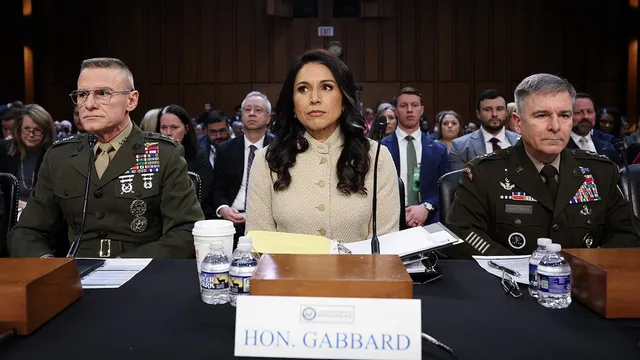
In Washington, D.C., Director of National Intelligence Tulsi Gabbard addressed a series of questions regarding the U.S. intelligence assessment on Iran during a worldwide threats hearing. The inquiry arose in the context of recent tensions with Iran, particularly following President Donald Trump's claims about the Iranian nuclear program allegedly posing an imminent threat to the U.S. Senate Intelligence Committee member Jon Ossoff specifically questioned Gabbard about whether the intelligence community had assessed that Iran was an imminent nuclear threat. Gabbard declined to give a direct affirmation, emphasizing that the determination of imminent threats rests with the president. Notably, her statements highlight a divergence from Trump's narrative that Iran's military and nuclear capabilities were an immediate danger. Furthermore, Gabbard countered claims regarding Iran's attempts to rebuild its nuclear weapons program, asserting that the Iranian regime has made 'no efforts' in that regard, which aligns with the intelligence assessments provided by her CIA counterpart, John Ratcliffe. This contradiction further complicates the administration’s portrayal of Iran as a significant threat. Gabbard went on to reaffirm that Iran's conventional military capabilities have suffered significant degradation, reducing its options in regional conflicts. Despite her role in representing the intelligence community, Gabbard sidestepped direct discussions about operational details regarding the potential Iranian response to U.S. actions, including incidents relating to the Strait of Hormuz, a critical maritime chokepoint for oil shipments. The hearing also reflected internal tensions within U.S. intelligence as some officials, including those from the National Counterterrorism Center, recently resigned over the handling of intelligence related to Iran, underscoring ongoing debates about the validity of threat assessments concerning Iran's capabilities and intentions.

Context

The current assessments of U.S. intelligence regarding Iran underscore a complex interplay of regional ambitions, nuclear activities, and evolving relationships with global powers. Iran's leadership continues to pursue a robust nuclear program, which remains at the forefront of U.S. intelligence concerns. Despite the diplomatic efforts aimed at reinstituting the Joint Comprehensive Plan of Action (JCPOA), U.S. intelligence indicates that Iran has made significant advancements in its uranium enrichment capabilities. These developments pose a short-term threat to regional stability and a long-term challenge to non-proliferation efforts globally. Intelligence reports suggest that Iran has amassed enriched uranium levels that bring them closer to the capability for rapid weaponization should they choose to proceed down that path. Such actions have raised alarms among U.S. officials and allies, particularly Israel, which views a nuclear-capable Iran as an existential threat. Alongside nuclear advancements, U.S. intelligence assesses that Iran remains actively involved in various proxy conflicts throughout the Middle East. The Islamic Revolutionary Guard Corps (IRGC) has been pivotal in supporting militant groups in countries such as Iraq, Lebanon, Syria, and Yemen. This support not only extends to arms and training but also encompasses financial resources that bolster these groups' capabilities to counter U.S. interests and allies in the region. The intelligence community has reported that these actions are part of Iran's broader strategy to extend its influence and counterbalance U.S. presence and alliances that have been established over the decades. U.S. assessments also highlight ongoing tensions between Iran and Gulf Arab states, especially concerning maritime security and regional stability. Intelligence indicates that Iran’s maritime activities, particularly in the Strait of Hormuz, remain aggressive, affecting global oil supply routes and increasing the risk of confrontations. Such engagement is seen by the U.S. as a means for Iran to assert its dominance and retaliate against perceived threats from U.S. military operations in the region. Simultaneously, internal pressures within Iran, influenced by economic sanctions and public dissent, are shaping its foreign policy, leading to a precarious situation where regional escalations remain a significant concern. In conclusion, the current U.S. intelligence assessments on Iran reflect a multifaceted challenge that encompasses nuclear proliferation, proxy warfare, and regional instability. The evolving dynamics suggest that Iran not only seeks to bolster its nuclear capabilities but also aims to leverage its influence through regional militias and aggressive maritime strategies. The synthesis of these elements underscores the necessity for a unified U.S. strategy that addresses both the immediate and long-term threats posed by Iran while considering the geopolitical complexities of the Middle East. As the situation continues to develop, U.S. intelligence will remain crucial for informing policy responses and maintaining strategic alliances in the region.

2026 All rights reserved
