

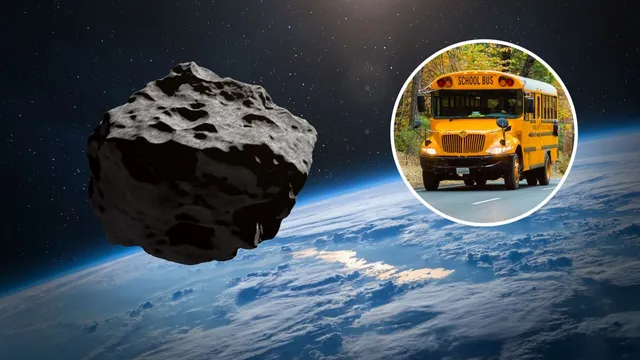
NASA warns of bus-sized asteroid approaching Earth
NASA warns of bus-sized asteroid approaching Earth
- NASA is monitoring asteroid 2025 YH3, which is 32 feet in diameter and traveling over 22,000 miles per hour.
- Today, the asteroid will come within 284,000 miles of Earth, while other larger asteroids are monitored as well.
- Despite the presence of these near-Earth objects, the majority pose no significant threat to our planet.
Story
On December 22, 2025, NASA announced that it is closely monitoring a bus-sized asteroid called 2025 YH3. This asteroid, measuring approximately 32 feet in diameter, is currently traveling toward Earth at speeds exceeding 22,000 miles per hour. Its closest approach to our planet is forecasted to occur today, with a mere distance of 284,000 miles separating it from Earth. Although this distance may seem vast on a human scale, in cosmic terms, it is relatively minor. NASA’s Center for Near Earth Object Studies (CNEOS) is keeping a keen eye on the trajectory of this asteroid to ensure public safety and scientific understanding of its path. Furthermore, NASA is also monitoring additional nearby asteroids, notably 2025 YC3, which is around 260 feet tall and another bus-sized object called 2025 XT7, measuring about 42 feet across. Both of these larger space rocks are expected to pass at a safe distance of approximately 2.4 million miles away from Earth, which indicates that while they pose no immediate threat, they are included in ongoing tracking efforts to study their movements and potential future trajectories. Asteroids are remnants from the formation of the solar system about 4.6 billion years ago and exist mainly in the asteroid belt located between Mars and Jupiter. Near-Earth objects, as classified by NASA, include those asteroids that approach within 120 million miles of the sun, entering Earth's orbital neighborhood. While a small percentage of these asteroids, termed potentially hazardous asteroids (PHAs), require more rigorous tracking due to their closer orbits, most near-Earth objects are found to have trajectories that pose no risk to our planet. In February of this year, NASA also examined the impact probability of another asteroid, designated 2024 YR4, which was assessed at 3.1 percent likelihood of impacting Earth in 2032. However, subsequent studies revealed that there was no significant risk involved with this potential encounter. NASA's monitoring efforts and public announcements reflect the space agency's dedication to maintain vigilance over celestial bodies that could pose threats to Earth, ensuring an informed public and adequate preparedness measures for potential future interactions with these space rocks.


