

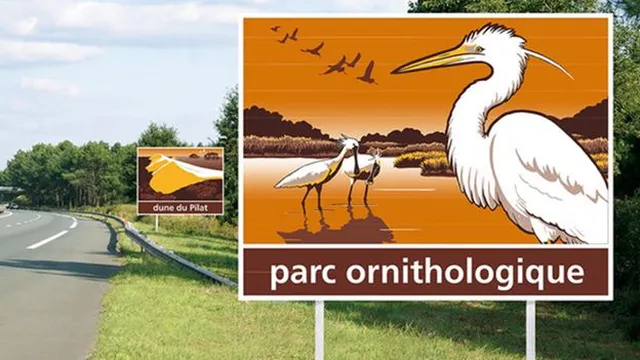
Motorway signs educate drivers about France's rich culture and history
Motorway signs educate drivers about France's rich culture and history
- France's brown motorway signs have provided insight into the country’s history and culture for over 50 years.
- Originally designed by Jean Widmer and Nicole Sauvage in 1972, the signs have become an iconic representation of French identity.
- The ongoing replacement of these signs indicates an effort to promote tourism while celebrating lesser-known aspects of French heritage.
Story
For more than 50 years, France's brown motorway signs have been more than simple navigational tools; they have served as a means to communicate the nation’s rich history and culture to drivers. First introduced in 1972, these signs quickly proliferated, with over 500 appearing within the subsequent seven years. The initial designs were crafted by Swiss-born designer Jean Widmer and his wife, Nicole Sauvage, who created many iconic visuals that resonate within modern France. Today, many of their designs are preserved at the Centre National des Arts Plastiques in Paris. Notably, the signs were designed with a focus on simplicity, as drivers traveling at the 130km/h speed limit needed to grasp the messages quickly. Each sign was usually placed on two panels situated approximately 200 to 300 meters apart to aid in visibility and comprehension at high speeds. The designs often conveyed complex ideas through recognizable symbols, reflecting Widmer's belief in the intelligence of the viewing public. In total, he created around 950 signs during his illustrious career, which helped to cement the brown sign’s role in promoting French heritage. In recent years, however, the original brown signs have faced replacement due to the conditions they were in; they were deemed old and sometimes posed safety risks. APRR/AREA, which operates about 30% of the French motorway network, has removed many of Widmer and Sauvage's original designs. Since 2014, the organization has commissioned a new team of illustrators to create around 600 updated panels. These new designs not only bring a fresh aesthetic but also highlight underrepresented aspects of French history and culture. Road signs are now being used to honor well-known figures from French history, such as artist Rosa Bonheur and writer Colette, showcasing the country as an open-air art gallery. The artists contributing to these signs have the opportunity to sign their works, adding a unique touch that reflects their individual styles. This shift in design philosophy indicates a continued effort to encourage motorists to explore the rich cultural offerings of France, reinforcing the idea that these signs represent more than road guidance; they serve as invitations to delve deeper into the country’s diverse legacy.
Context
The history of French motorway signs dates back to the development of the motorway network in France, which began in the mid-20th century. The first French motorways were established in the 1960s, and this was accompanied by the need for a standardized system of road signage to ensure safe and efficient travel. The initial approach to road signs was largely influenced by existing conventions in other European countries, but France sought to create a unique identity for its signage that would be easily recognizable to both local and international drivers. In 1965, the French government adopted a comprehensive set of regulations that established a uniform system of road signs across the nation, ensuring clarity and consistency in their design and usage. This marked a significant step in enhancing road safety and navigation for motorists. The designs of French motorway signs reflect both practicality and culture. The use of vivid colors, such as blue for motorways and green for expressways, helps to differentiate the types of roads, while the pictograms and typefaces employed are clear and straightforward, reducing ambiguity. Over time, the system has evolved to incorporate symbols that resonate with contemporary drivers, including directional signs, distance markers, and services available along the route. Starting from a simple set of directional signs, the current system has grown to include detailed information about travel conditions, traffic regulations, and services, adapting to the increasing volume of traffic and diverse needs of drivers. In the 1990s, France introduced a new generation of signs, including digital displays that provided real-time information about traffic conditions and obstacles. This integration of technology into road signage represents a significant advancement in highway management and traveler information systems. The adoption of these smart signs has helped not only in alleviating congestion but has also provided essential updates concerning weather conditions and accidents, thereby enhancing safety on the network. The continuous updates and improvements to the signage system are crucial in responding to technological advancements and changes in driver behavior and expectations. Today, French motorway signs are considered a leading example of effective road signage design. They have been influential in shaping road sign policies in other countries, serving as a model for clarity, functionality, and aesthetic appeal. The commitment to continually improve road signage ensures that as driving environments evolve, safety remains a top priority. Looking forward, the incorporation of new technologies, such as artificial intelligence in traffic management, suggests that French motorway signs will continue to adapt and evolve, further enhancing the travel experience for drivers.


