

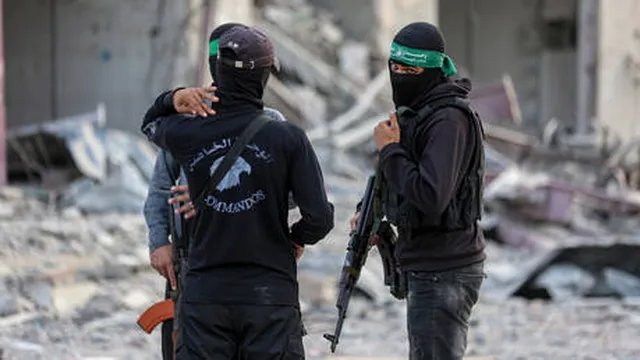
Hamas agrees to transfer Gaza governance under Trump's peace plan
Hamas agrees to transfer Gaza governance under Trump's peace plan
- Hamas is poised to transfer full governance of Gaza to the NCAG as part of a U.S.-backed peace plan.
- The proposed governance structure aims to alleviate the ongoing humanitarian crisis while managing Israel's security concerns.
- The agreement reflects a complex interplay between local factions and international stakeholders in the quest for lasting peace.
Story
In late 2023, the militant group Hamas announced its readiness to hand over governance of Gaza to a newly established Palestinian technocratic committee, the National Committee for the Administration of Gaza (NCAG). This decision is linked to U.S. President Donald Trump's peace plan, which outlines the disarmament of Hamas and the establishment of a ceasefire between Hamas and Israel aimed at resolving ongoing conflicts. The announcement was made by Hamas spokesman Hazem Qassem, who stressed the group's preparedness to transfer control of all ministries, agencies, and departments, including those in the security sector. The decision to hand over governance follows a ceasefire agreement supported by the United States, which came into effect in late 2023. This agreement was established after a conflict that resulted in significant casualties, with Hamas militants attacking Israel and leading to a military response that inflicted substantial damage on Gaza. The international community's response to this situation has been mixed, with various nations either supporting or rejecting the terms of the peace efforts proposed by Trump. Israeli Prime Minister Benjamin Netanyahu reiterated that the reconstruction of Gaza would not commence until Hamas completely disarms, underscoring the contentious nature of the peace negotiations. As part of Trump's broader strategy for Middle Eastern peace, the NCAG is to be managed by a Board of Peace chaired by Trump himself. The board aims to incorporate numerous world leaders and provide a framework for governance and development in Gaza. Despite these efforts, several key countries, including France and the United Kingdom, have expressed skepticism regarding the initiative, raising concerns about its mandate and the implications for existing global peace frameworks. The fallout from this continuing conflict has led to immense humanitarian crises in the region, complicating the governance transition and peace efforts. With Belarus joining the Board of Peace as a founding member in January 2026, the board continues to attract attention. Its formation signifies a changing landscape in international relations concerning the Gaza conflict. The developments highlight ongoing tensions in the region, with both Hamas and Israel accusing each other of ceasefire violations. The broader implications of these developments raise questions about future governance and peace in the area as the situation remains fluid and uncertain.
Context
Hamas, a Palestinian Islamic organization, emerged in the late 1980s as a significant force in the Israeli-Palestinian conflict. It was founded during the First Intifada against Israeli occupation, promoting a militant Islamist ideology intertwined with Palestinian nationalism. The group is characterized by its social services, military wing, and political activities, seeking to establish an Islamic state in historic Palestine. Initially an offshoot of the Egyptian Muslim Brotherhood, Hamas gained popularity through its provision of social services, including education, healthcare, and welfare programs, appealing to many Palestinians disenchanted with the Palestinian Authority's governance and perceived corruption. Over the years, Hamas has carried out numerous attacks against Israel, which has significantly impacted its relations with various international actors and has made it a focal point of geopolitical debates in the Middle East. In 2006, Hamas gained a major political breakthrough by winning the Palestinian legislative elections, leading to tension and eventual conflict with the rival Fatah party. This conflict culminated in June 2007 when Hamas forcibly took control of the Gaza Strip after a series of violent clashes. Since then, Gaza has been governed by Hamas under a siege imposed by Israel and Egypt, significantly impacting the region's economy and living conditions. Under Hamas governance, the territory has faced challenges such as high unemployment rates, limited access to resources, and frequent military confrontations with Israel. Despite these hardships, Hamas has maintained a firm grip on power, largely due to its military capabilities, social services network, and ideological positioning. Hamas's dual role as a governing body and militant organization has resulted in persistent complexities within the Gaza Strip. The governance model implemented by Hamas combines authoritarian control with a populist approach, including the continuation of social services while suppressing dissent. This strategy has allowed Hamas to secure a degree of popular support, despite hardships faced by the population due to blockades and military conflicts. Additionally, Hamas has worked to reinforce its legitimacy by positioning itself as a resistance movement against Israeli occupation, often drawing upon historical narratives and cultural symbols of Palestinian identity to bolster its political standing. The international community's response to Hamas has been deeply polarized. Countries such as the United States and members of the European Union classify Hamas as a terrorist organization, primarily due to its military actions against civilians and refusal to recognize Israel's right to exist. However, other nations and NGOs view the group through a lens of a legitimate political actor representing Palestinian aspirations. As of January 2026, the situation in Gaza remains precarious, marked by ongoing conflicts, humanitarian crises, and political divisions both within Palestine and in the broader Middle East. The future governance of Gaza under Hamas, and the possibility of reconciliation with the Palestinian Authority, will continue to influence the region's stability and the prospect for a lasting peace between Israelis and Palestinians.


