

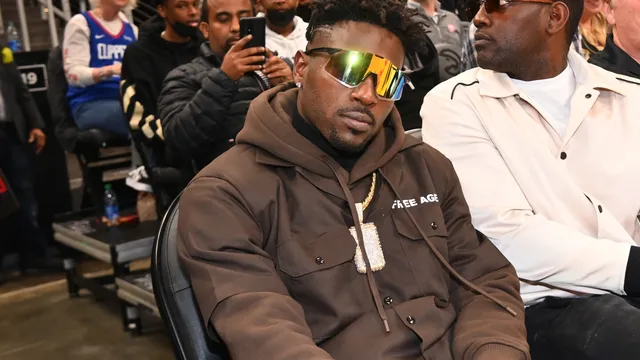
Antonio Brown faces potential 30 years prison time for attempted murder charge
Antonio Brown faces potential 30 years prison time for attempted murder charge
- Antonio Brown was extradited from Dubai to face an attempted murder charge related to a May incident.
- He was released on $25,000 bail but must wear a GPS monitor and has restrictions on travel.
- If convicted, Brown could face a maximum of 30 years in prison, significantly impacting his future.
Story
Antonio Brown, the former NFL star, was extradited from Dubai to the US to face charges of attempted murder related to an incident that took place during a celebrity boxing event in Miami in May 2025. Following a dispute at the event, Brown allegedly fired shots at another individual after grabbing a handgun from a security staff member. He was unable to avoid capture for over four months, during which he shared posts on social media that showcased his lifestyle, leading to his eventual apprehension by US Marshals in Dubai. After returning to the US, Brown was placed in a Miami correctional facility while awaiting trial. On November 16, less than a week after he arrived back in the US, Brown pleaded not guilty at his arraignment. His attorney asserted that Brown acted in self-defense, alleging he was being threatened after a legal dispute with the alleged victim concerning stolen jewelry. Brown’s attorney argued that he was simply defending himself in a situation where his safety was in jeopardy. Following the hearing, Brown was released on a $25,000 bond but must comply with strict conditions, including the wearing of a GPS ankle monitor and receiving court permission for any travel. Prosecutors indicated serious consequences for Brown, as he could face a maximum of 30 years in prison if convicted, primarily due to the alleged use of a firearm during the event. The severity of the potential sentence stems from Florida's 10-20-Life law, which enhances penalties for crimes involving guns. This law outlines that because a firearm was allegedly discharged, the usual maximum sentence for second-degree attempted murder of 15 years could be doubled. As the case develops, public interest remains high, with speculation on the implications for Brown, who had a successful NFL career before facing legal struggles. His trial has not yet been scheduled, with the next hearing set for December 22, leaving many questions about his future both personally and professionally. Brown's situation has garnered significant attention, with media reports focusing on his past achievements and the drastic turn his life has taken amidst these serious legal troubles.
Context
Florida's attempted murder law encompasses a range of legal principles and penalties associated with the act of attempting to unlawfully kill another individual. Under Florida Statutes, attempted murder is classified into two degrees: first-degree and second-degree. First-degree attempted murder, defined under Florida Statute 782.051, occurs when an individual intends to kill another person and takes a substantial step toward that goal. This offense is a felony of the first degree, which carries severe penalties including a mandatory minimum sentence of 20 years, with the possibility of life imprisonment. The prosecution must prove beyond a reasonable doubt that the defendant not only intended to commit murder but also took actions towards carrying out the act. Such actions could include pulling a weapon, planning an attack, or any act that could reasonably be interpreted as a tangible step towards the commission of murder. Accomplices to attempted murder can also be charged if they played a role in the planning or execution of the attack. The law recognizes that an attempt does not require the actual commission of murder; indeed, the mere attempt is sufficient for prosecution given the intent and actions demonstrate a clear purpose to kill. Second-degree attempted murder, on the other hand, does not require the intent to kill but rather involves reckless conduct that shows a disregard for human life. This is addressed under Florida Statute 782.04, which details that a person can be charged with second-degree attempted murder if they engage in conduct that could easily result in the death of another person, even if it was not their intention to kill. This type of attempted murder is considered a second-degree felony, and it carries a punishment that can range from 15 years to 30 years in prison. The distinction between first-degree and second-degree attempted murder is crucial because it represents differing levels of intent and the resulting legal consequences. Furthermore, the legal definition of 'attempt' in Florida law has evolved to ensure that those who take significant steps towards committing murder are held accountable, thereby serving as a deterrent against violent crime. In addition to the legal definitions and potential punishments, the Florida legal system employs a set of defenses that may be applicable in cases of attempted murder. Defendants may claim affirmative defenses such as self-defense or defense of others, asserting that their actions were justified under the circumstances. Florida law also provides for the possibility of a judgment of acquittal if, at trial, evidence is insufficient to prove intent or actions supporting the charge. Such defenses present a significant aspect of attempted murder cases, as they require a careful examination of the facts and circumstances surrounding the incident. The burden of proof lies with the prosecution, so even in attempted murder cases where evidence seems compelling, the defendant has rights and options to challenge the charges. Overall, the attempted murder laws in Florida represent a vital aspect of the state's legal framework aimed at preventing violent crime and holding individuals accountable for their actions. The classification of attempted murder into first and second degree allows courts to administer justice proportionally to the intent and actions exhibited by the accused. Furthermore, ongoing legal discussions around the application and interpretation of these statutes continue to shape the legal landscape. Understanding the nuances of these laws is essential for legal practitioners, as they navigate the complexities of charges, defenses, and the ramifications of attempted murder in Florida.


