

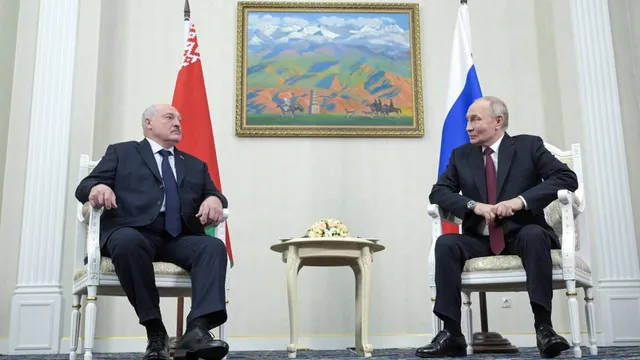
Putin promises new weapons for CSTO members to strengthen military leadership
Putin promises new weapons for CSTO members to strengthen military leadership
- Vladimir Putin announced plans to provide CSTO members with advanced Russian military hardware during a summit in Kyrgyzstan.
- Strengthening the rapid-response forces of the CSTO is a key objective as Russia assumes the chairmanship.
- The focus on modern military technology underscores the evolving security dynamics in Eurasia.
Story
In Kyrgyzstan, leaders of the Collective Security Treaty Organization (CSTO) gathered to discuss the importance of military technology leadership. Russian President Vladimir Putin emphasized that military readiness and advancements in technology are critical as Russia assumes the chairmanship of the CSTO. He announced plans for a large-scale program to rearm CSTO collective forces with proven Russian military hardware, advocating for upgraded resources beneficial for members which include Belarus, Armenia, Kazakhstan, Kyrgyzstan, and Tajikistan. This commitment highlights a shift in CSTO's focus towards enhancing its collective-defense framework amid rising global security concerns. As the CSTO traditionally addresses counter-terrorism and anti-drug operations, the necessity for a robust defense strategy is more pronounced than ever in facing threats that challenge the sovereignty and territorial integrity of its members. Moreover, Putin's assurances come at a time when Russia's defense industry is rapidly evolving, especially amid the ongoing conflict in Ukraine, which has showcased innovations like drone warfare. This development reflects Russia's intent to maintain a military edge and implies a direct response to the geopolitical dynamics shaping security alliances across Eurasia. Additionally, the assertions about CSTO's capabilities align with past remarks by Putin who has claimed the organization ensures security within the Eurasian space. The culmination of military technology advancements and collective defense initiatives could radically transform the security landscape in the region. As the security alliance repositions itself, tensions remain elevated, demanding international attention as the conflict in Ukraine unfolds.
Context
The Collective Security Treaty Organization (CSTO) is a regional military alliance established in 1992, primarily aimed at addressing security challenges in the post-Soviet space. The CSTO originated from the Collective Security Treaty, which was signed by seven former Soviet republics and was intended to counteract NATO's influence in Central Asia and Eastern Europe. Over time, the organization has evolved, with the aim of enhancing collective defense among member states, which include Armenia, Belarus, Kazakhstan, Kyrgyzstan, Russia, and Tajikistan. The CSTO's mission emphasizes political, military, and economic cooperation to ensure regional stability and security, with a focus on combating terrorism, drug trafficking, and organized crime that threaten the integrity of its member states. Additionally, the organization's health and effectiveness are sometimes evaluated through its involvement in joint military exercises and peacekeeping operations, which help to bolster the defense capabilities of member nations. The CSTO operates on principles of mutual assistance, where an attack against one member is considered an attack against all, reminiscent of NATO's Article 5. While the CSTO's ability to address security threats has been tested by various crises, including conflicts in Armenia and the unrest in Kyrgyzstan, its overall effectiveness has been a topic of debate among analysts and political commentators. Critics often point to divergent interests among member states and Russia's dominant role as limiting the organization's responsiveness to threats. However, the CSTO's strategic significance continues to grow in light of shifting global security dynamics and the desire among member nations to maintain sovereignty while fostering regional alliances. As geopolitical tensions rise, particularly with NATO and other Western influences in the region, the CSTO could play a crucial role in maintaining a balance of power and providing a platform for collective action among its members. In the context of global security, the CSTO has sought to align its objectives with broader international frameworks while addressing localized concerns. Its stance towards non-regional organizations has evolved to allow for dialogues on issues such as counter-terrorism and disaster response, reflecting a growing recognition of the importance of cooperative security measures. Nevertheless, the CSTO's reputation on the global stage is complicated by perceptions of it being a tool for Russian influence. The organization has been engaged with the United Nations in peacekeeping missions and participates in various security summits, signaling its aspiration to contribute to international security discussions while maintaining its regional focus. Looking forward, the CSTO faces considerable challenges in adapting to the rapidly changing security environment. This includes addressing internal disparities among members regarding military spending, political will, and the necessity for reform. To solidify its role and enhance its efficacy, the organization must navigate these complexities, fostering greater unity among its members while developing strategic partnerships both regionally and globally. As global security concerns evolve, the CSTO's adaptability and commitment to collective defense will be crucial in determining its success in ensuring the stability and security of its member states in an increasingly volatile world.


