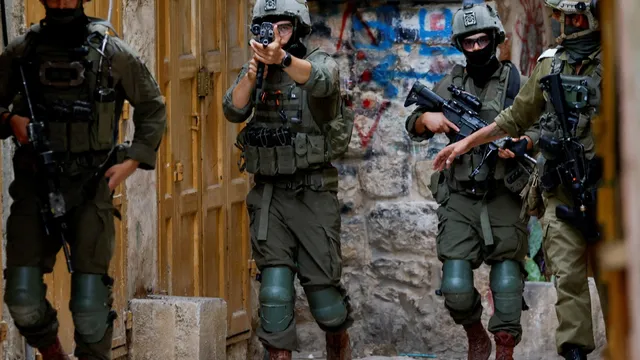
Israeli settlers rampage in West Bank, torch mosques and detain Palestinians
military conflicts
controversial
tragic

Israeli settlers rampage in West Bank, torch mosques and detain Palestinians

11
(Update: )
Prime Minister of Israel (1996–1999, 2009–2021, 2022–present)
  • Israeli settlers have been involved in violent actions in the occupied West Bank, including the torching of mosques.
  • The violence follows the killing of four Palestinians by Israeli forces during a settler incursion.
  • The situation has led to increased tensions and fears among Palestinians, with a significant rise in settler attacks.
Share opinion
1

Story

In the occupied West Bank, tensions have escalated significantly following a series of violent incidents involving Israeli settlers and Palestinian residents. Over the past few days, Israeli settlers, reportedly backed by military forces, have engaged in aggressive actions, including the torching of at least two mosques and the detention of dozens of Palestinians. These events occurred shortly after Israeli forces shot dead four Palestinians in the town of Tal, near Nablus, during a settler incursion. The violence has left the Palestinian community on high alert, with many residents fearing for their safety and the security of their homes. The situation intensified after Israeli Prime Minister Benjamin Netanyahu vowed to avenge the killings of the Israelis involved in the confrontation, stating that the military was prepared to take broader action against what he termed 'terrorist strongholds.' His comments have been interpreted as a call for increased military operations in Palestinian areas, which has further fueled fears among Palestinians of impending violence and repression. Reports indicate that Israeli settlers have carried out at least 30 attacks across the Palestinian territory since Friday, marking a significant increase in such incidents. Local Palestinian officials have reported that settlers torched a mosque in the village of Qusra, where attackers also spray-painted slogans in Hebrew, including messages of 'Jewish revenge.' In another incident, settlers attempted to set fire to a mosque near Kour, but local worshippers managed to extinguish the flames before significant damage occurred. Surveillance footage captured settlers setting fire to a Palestinian home in Beit Furik, highlighting the ongoing violence and intimidation faced by Palestinian communities in the region. The surge in settler violence has been alarming, with Israeli Army Radio reporting a 63 percent increase in settler attacks in the first half of 2026 compared to the previous six months. This trend has resulted in a growing number of casualties, with at least 1,185 Palestinians killed in the occupied West Bank since October 2023, including 250 children. The situation remains dire, with many Palestinians feeling the need to stay awake at night to protect their homes from potential arson attacks. The Palestinian Prisoner’s Society has reported that among those detained are former Palestinian prisoners, indicating a broader crackdown on the Palestinian population amid the escalating violence.

Context

The history of violence between Israeli settlers and Palestinians is a complex and multifaceted issue that has evolved over decades, deeply rooted in historical, political, and social contexts. The conflict can be traced back to the late 19th and early 20th centuries, with the rise of nationalist movements among both Jews and Arabs in the region. Tensions escalated significantly after the establishment of the State of Israel in 1948, which led to the displacement of a large number of Palestinians, an event referred to as the Nakba, or "catastrophe." This period marked the beginning of a long-standing conflict characterized by violence, territorial disputes, and deep-seated animosities that have persisted to this day. In the years following the establishment of Israel, violence between Israeli settlers and Palestinians intensified, particularly during the Six-Day War in 1967, when Israel occupied the West Bank and Gaza Strip. The occupation led to the establishment of Israeli settlements in these territories, which have been a major source of conflict. Settlers often clashed with Palestinian residents, leading to violent confrontations, property destruction, and loss of life on both sides. The Israeli government's support for settlement expansion has further exacerbated tensions, as Palestinians view these actions as encroachments on their land and rights. The violence has not been one-sided; Palestinian groups have also engaged in acts of violence against Israeli settlers and military personnel. This includes both organized attacks and individual acts of violence, often in response to perceived injustices or provocations. The cycle of violence has been perpetuated by retaliatory actions from both sides, creating an environment of fear and mistrust. International efforts to mediate the conflict have often been met with limited success, as both parties remain deeply entrenched in their positions, making compromise difficult. In recent years, the situation has continued to evolve, with periodic escalations in violence, particularly during times of heightened political tensions or significant events, such as the recognition of Jerusalem as Israel's capital by the United States in 2017. The ongoing violence has had devastating effects on both Israeli and Palestinian communities, leading to loss of life, injuries, and psychological trauma. The international community remains divided on how to address the conflict, with various proposals for peace often falling short of achieving lasting solutions. The history of violence between Israeli settlers and Palestinians is a stark reminder of the complexities of the conflict and the urgent need for a resolution that addresses the rights and aspirations of both peoples.