

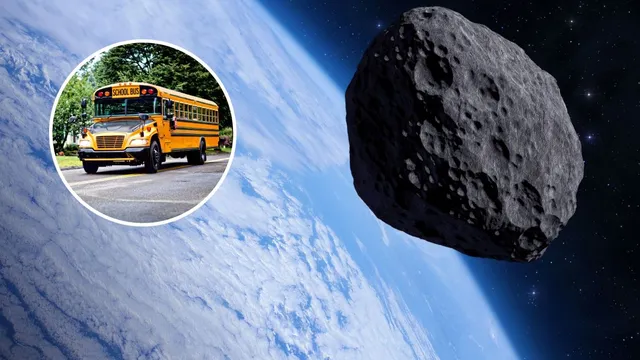
NASA tracks bus-sized asteroid speeding towards Earth
NASA tracks bus-sized asteroid speeding towards Earth
- NASA is currently tracking an asteroid named 2026 EG1, which is about 40 feet in diameter.
- This asteroid is expected to come as close as 198,000 miles to Earth, which is less than the distance to the Moon.
- The ongoing monitoring of near-Earth objects by NASA includes identifying those that may pose risks, though the majority do not.
Story
On March 12, 2026, NASA is actively monitoring a bus-sized asteroid named 2026 EG1 that is racing towards Earth at a velocity exceeding 21,500 miles per hour. This asteroid measures approximately 40 feet in diameter and is set to make its closest approach to Earth, coming within 198,000 miles of the planet. This distance is notably less than the average distance from the Earth to the Moon, which is about 239,000 miles, according to NASA's Jet Propulsion Laboratory. The agency's Center for Near Earth Object Studies (CNEOS) has been closely observing this and similar objects to ensure there are no potential risks for Earth. Asteroids are remnants from the formation of our solar system around 4.6 billion years ago and are primarily located in the main asteroid belt situated between Mars and Jupiter. Some of these bodies, however, have orbits that cross into the inner solar system, categorizing them as near-Earth objects. According to NASA, these near-Earth objects can come within 120 million miles of the Sun and near Earth's orbital neighborhood, thereby increasing the significance of monitoring their paths closely. While NASA maintains vigilant surveillance over many of these near-Earth objects, the potential hazards are limited. The majority of these asteroids possess orbits that do not pose immediate threats to Earth. Yet, a small subset classified as potentially hazardous asteroids (PHAs) requires further attention, especially as their trajectories could evolve to result in close encounters in the future. NASA indicated that PHAs have trajectories that may bring them as close as within 4.6 million miles of the Earth's path around the sun. In an earlier instance in 2025, scientists discovered a record-breaking asteroid named 2025 MN45, which not only spins at an extraordinary pace but also spans nearly eight football fields in width. This highlights the broader category of asteroids that vary significantly in size and behavior. Moreover, NASA had previously announced in February 2025 that another asteroid named 2024 YR4 had a 3.1 percent chance of impacting Earth in 2032. However, subsequent observations reassured that there was no significant impact risk posed to the planet beyond that time frame. Overall, while there are many near-Earth objects to monitor, NASA confidently states that none of these pose a significant impact threat to Earth in the immediate future.


