

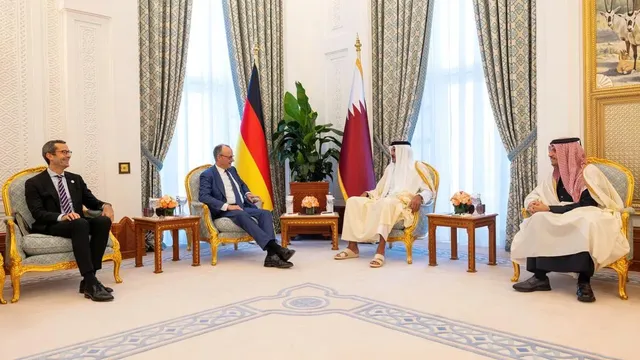
Friedrich Merz promises increased arms cooperation with Gulf states
Friedrich Merz promises increased arms cooperation with Gulf states
- Friedrich Merz announced a less-restrictive stance on arms exports to Gulf states during his visit to Qatar.
- Germany aims to diversify its energy sources and increase liquefied natural gas imports from Qatar.
- This arms cooperation is viewed as essential for mutual security and is part of a larger strategy to enhance economic ties.
Story
During a diplomatic visit to Qatar on February 5, 2026, German Chancellor Friedrich Merz announced a shift in Germany's approach to arms exports to Gulf nations. This comes at a time when Germany is looking to diversify its energy sources and strengthen economic ties with these countries, amidst changing global trade dynamics influenced by U.S. tariff policies. Merz's delegation included CEOs from major companies such as Uniper and Diehl Defence, indicating a strong focus on enhancing business opportunities alongside military cooperation. Merz emphasized the importance of deepening arms cooperation with reliable partners in the Gulf region, stating that such collaboration is essential for mutual security. The Chancellor's commitment to expanding arms exports has been shaped by ongoing global security concerns, particularly as tensions between Iran and the United States rise. In addition, expanding the volume of liquefied natural gas imports from Qatar is a significant goal, aiming to increase from 2 million tons annually to ensure a stable energy supply. The discussions also touched upon human rights issues, an important and sensitive topic given previous incidents such as the assassination of journalist Jamal Khashoggi. Merz acknowledged these matters were raised during his meetings, reflecting Germany's balancing act between economic interests and ethical concerns. Merz's assertive stance on arms exports signals a decisive turn in Germany's foreign policy, aiming to position the country as a formidable ally for Gulf states. Later in his trip, Merz will continue to promote similar themes during meetings in Saudi Arabia and the United Arab Emirates, seeking to solidify partnerships that extend beyond mere economic transactions to include critical defence arrangements. Inviting Qatar's emir to Berlin for an official visit in July underlines Germany's intent to further nurture these strategic relationships well into the future.
Context
The impact of U.S. tariff policies on German trade has become increasingly significant in recent years, particularly as global economic dynamics have evolved. As one of the largest economies in Europe, Germany relies heavily on international trade, and changes in U.S. tariff structures can have profound implications for its exporters and overall economic health. The U.S. tariffs, especially those imposed under the previous administration's trade policies, have created a complex environment for German companies, prompting them to adapt their strategies in order to maintain competitiveness in the U.S. market. In response to the tariff policies, German businesses, particularly those in the automotive and manufacturing sectors, have faced rising costs associated with their exports to the U.S. These tariffs have not only increased the price of German goods in the American market but have also prompted a reevaluation of supply chains. As a result, many companies have sought to diversify their markets or relocate some manufacturing processes closer to the U.S. to mitigate the impact of tariffs. This shift not only represents a change in trade flows but also underscores the importance of strategic planning within German firms to safeguard their positions in key international markets. Moreover, the retaliatory tariffs imposed by the EU in response to U.S. trade measures have led to a cycle of escalating trade tensions. This has had ripple effects not just for German exports to the U.S., but also for imports, which have faced increased scrutiny and costs. Such measures have raised concerns among policymakers regarding the stability of transatlantic relations and the overall health of international trade. In light of these developments, German economists and trade experts have emphasized the importance of diplomatic engagement to resolve trade disputes and ensure a more stable trading environment moving forward. Finally, as of early 2026, the broader implications of U.S. tariff policies continue to unfold. The long-term effects of these tariffs are likely to be felt over several years, as industries adjust and realign their strategies. Tracking the change in German trade balances, export volumes, and market access is critical for understanding the full impact of U.S. tariff policies. In summary, German trade has been fundamentally affected by U.S. tariff policies, as firms navigate through challenges and revise strategic objectives to adapt to a shifting economic landscape.


