

China builds first nuclear-powered aircraft carrier to challenge U.S
China builds first nuclear-powered aircraft carrier to challenge U.S
- China is constructing its first nuclear-powered aircraft carrier, Type 004.
- The PLAN's naval modernization under Xi Jinping aims for a world-class military by 2049.
- This development signals a potential escalation in the regional arms race and maritime competition.
Story
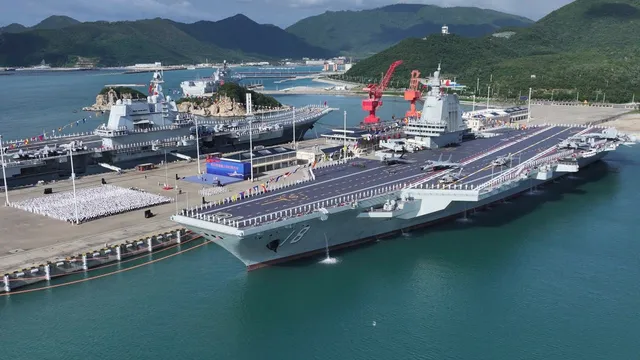
China is advancing the construction of a new aircraft carrier, designated Type 004, likely to be its first equipped with nuclear propulsion. Recent reports have surfaced indicating that the People's Liberation Army Navy (PLAN) has commissioned the Fujian, its first domestically produced advanced-generation aircraft carrier, as part of its broader naval modernization efforts under President Xi Jinping. The Type 004's dimensions suggest an overall displacement between 105,000 and 110,000 tons, with leaked images depicting a reactor containment structure akin to those found on U.S. nuclear-powered vessels, hinting at the possibility of nuclear capabilities. Analysts believe that the carrier could significantly enhance China's ability to project power globally, with minimal refueling needs, thus extending its operational range substantially. This nuclear-powered carrier reflects China's ambition to increase its maritime strength and capability to operate autonomously over extended periods, in contrast to the conventional carriers it currently possesses. The U.S. Navy, which operates multiple active nuclear-powered supercarriers, has long been dominant in this area. Furthermore, the construction reflects a transformative phase in military competition, with geostrategic implications for the Indo-Pacific. The naval arms race is intensifying globally, as countries like Turkey and France also embark on developing next-generation aircraft carriers. Additionally, China's naval expansion is viewed critically by Western nations, with analysts warning that the development may spur a regional arms race, particularly concerning U.S.-China relations. Liang-chih Evans Chen has pointed out in his research that these developments could fundamentally reshape power dynamics in the region, leading to heightened competition in maritime security. China is determined to achieve a
Context
The impact of China's naval modernization on regional security is a critical area of study given the ongoing shifts in the balance of power in the Asia-Pacific region. China has embarked on an extensive modernization program for its naval forces, which has significantly increased its capabilities and assertiveness in maritime affairs. This modernization includes the development of advanced submarines, aircraft carriers, and surface combatants, coupled with the enhancement of its naval aviation and anti-access/area denial (A2/AD) capabilities. As a result, China's navy has transformed from a primarily coastal defense force into a more powerful blue-water navy capable of projecting its influence far beyond its shores, thereby affecting not only regional security dynamics but also the broader strategic landscape involving the United States and its allies in the region. One significant consequence of China's naval modernization is the increasing tension in the South China Sea, where China has asserted extensive territorial claims, often in direct conflict with those of neighboring countries such as Vietnam, the Philippines, and Malaysia. The construction of artificial islands and military installations has further exacerbated these tensions, leading to confrontations at sea and a rise in militarization in what is one of the world's busiest maritime trade routes. The U.S. and allied nations have responded with freedom of navigation operations and joint military exercises designed to counter China's expanding influence, which in turn may escalate regional rivalries and contribute to instability. This situation is compounded by the oscillating diplomatic relations among regional states, which are often caught between the need for cooperation with China and the necessity of maintaining their sovereignty and security. Moreover, as China's naval capabilities grow, neighboring countries are also responding by enhancing their own military capabilities and seeking closer ties with the United States and other allies. Japan, India, Australia, and Southeast Asian nations are investing in naval modernization efforts, which heighten the perception of a regional arms race. This reactive approach could lead to a security dilemma where the increase in one nation's military capabilities results in others feeling threatened, prompting further military buildups. The strategic responses from regional powers highlight a reconfiguration of alliances and partnerships in the face of China's assertiveness, emphasizing the importance of multilateral security dialogues and confidence-building measures to mitigate the risks associated with naval competition. Lastly, the implications of China's naval modernization on regional security extend to global trade and maritime security. The South China Sea is not only a flashpoint for military tensions but also vital for international shipping and trade flows. As China strengthens its naval presence, other countries' access to this essential waterway may be threatened, leading to higher stakes in any potential conflict. The necessity for secure maritime routes calls for a collaborative approach among regional powers to ensure that freedom of navigation is maintained while addressing the legitimate security concerns of all involved parties. Overall, China's naval modernization poses complex challenges to regional security that require thoughtful policy responses and enhanced diplomatic efforts to foster stability and cooperation in an increasingly multipolar world.


