

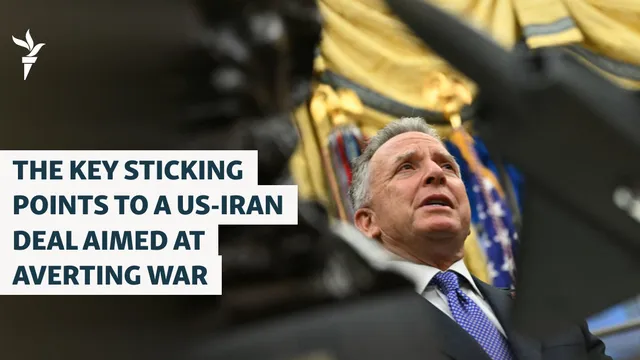
Trump says Iran is negotiating seriously with the U.S
Trump says Iran is negotiating seriously with the U.S
- Amid rising tensions, President Trump claims Iran is engaged in serious negotiations with the U.S.
- Military options are being considered as U.S. naval forces move closer to the Iranian coast.
- Continued negotiations may offer a path to a peaceful resolution amidst fears of regional conflict.
Story
In recent days, escalating tensions between the United States and Iran have captured global attention. U.S. President Donald Trump expressed his belief that Iran is engaging in serious negotiations, emphasizing his hope for an acceptable resolution as military options are considered. The remarks were made against the backdrop of significant military deployments, including a powerful naval fleet heading toward the Middle East, to underscore U.S. readiness amid ongoing protests in Iran and a violent government crackdown against dissenters. This Iranian upheaval and the subsequent threat of military action have intensified diplomatic discussions and fears of regional conflict. As protests have surged in Iran, leading to reports of numerous deaths and government crackdowns, Iranian leadership has responded with threats of retaliation should the U.S. decide to take military action. Ayatollah Ali Khamenei has warned that any conflict with the U.S. would escalate into a regional war, indicating Tehran's sensitivity to American intentions and its efforts to showcase its resolve. U.S. Navy forces have moved into the vicinity, further heightening concerns about a possible spark leading to open conflict. The underlying causes of the unrest in Iran can be traced to economic difficulties and widespread dissatisfaction with the government. The protests initially started over economic grievances, primarily the rising cost of living and inflation. However, they quickly transformed into broader anti-government demonstrations, posing significant challenges to the Iranian regime. This unrest has prompted a highly charged response from Tehran, which the U.S. claims is tied to a crackdown on dissent, attracting international scrutiny and condemnation. President Trump has publicly affirmed that his administration will not disclose military plans to Gulf allies while negotiations with Iran continue. The situation remains complex, as neither side appears willing to back down fully. Iran's leaders, while signaling a willingness to negotiate, have also conveyed that they stand ready to defend against any potential aggression from the West. Therefore, while negotiations might yield results, significant distrust persists on both sides, making the prospect of a breakthrough tenuous.
Context
The history of U.S.-Iran relations is marked by a series of complex interactions influenced by geopolitical, economic, and cultural factors. Initially, during the early 20th century, Iran and the United States enjoyed cordial relations, largely due to U.S. interests in securing access to Iranian oil and countering British influence in the region. This dynamic shifted dramatically in 1953 when the CIA orchestrated a coup to overthrow Iran's democratically elected Prime Minister, Mohammad Mossadegh. This event significantly impacted Iranian perceptions of the U.S., leading to deep-seated distrust among Iranians towards American policies and intentions in the region. The coup paved the way for the reinstallation of the Shah, Mohammad Reza Pahlavi, who ruled with an autocratic approach and relied heavily on U.S. support, further alienating significant segments of the Iranian population. In 1979, the Iranian Revolution radically transformed U.S.-Iran relations when the Shah was overthrown, leading to the establishment of the Islamic Republic under Ayatollah Khomeini. The revolution was met with hostility from the U.S., culminating in the Iran Hostage Crisis, during which 52 American diplomats and citizens were held hostage for 444 days. U.S.-Iran relations entered a prolonged period of hostility, marked by the imposition of economic sanctions and the severance of diplomatic ties. The U.S. viewed Iran's theocratic government as a major threat to regional stability and its interests, especially as Iran began to support groups opposed to U.S. involvement in the Middle East, including Hezbollah in Lebanon and various Shia militant groups in Iraq. The 1980s saw further deterioration in relations, especially during the Iran-Iraq War, when the U.S. provided support to Iraq, positioning it as a counterbalance to Iran. Following the end of the war, the U.S. adopted a policy of containment towards Iran, aiming to curtail its influence in the region. Tensions escalated in the early 2000s following the September 11 attacks, with the U.S. labeling Iran as part of the "Axis of Evil". This rhetoric intensified after the discovery of Iran's nuclear program, leading to fears that Iran was pursuing nuclear weapons. The international community, including the U.S., responded with sanctions, aiming to pressure Iran into abandoning its nuclear ambitions. However, a significant shift occurred in 2015 with the Joint Comprehensive Plan of Action (JCPOA), an agreement reached between Iran and six world powers (the U.S., U.K., France, Russia, China, and Germany) aimed at curbing Iran's nuclear capabilities in exchange for sanctions relief. This agreement represented a rare moment of diplomatic engagement but was short-lived; in 2018, the U.S. unilaterally withdrew from the JCPOA, reinstating sanctions and escalating tensions further. The subsequent years saw a series of confrontations, including attacks on oil tankers in the Persian Gulf and the U.S. assassination of Iranian General Qassem Soleimani in 2020. The relationship remains fraught, with ongoing disputes over nuclear arms, regional influence, and human rights, reflecting an enduring legacy of mutual distrust and geopolitical rivalry that continues to shape Middle Eastern geopolitics.


