
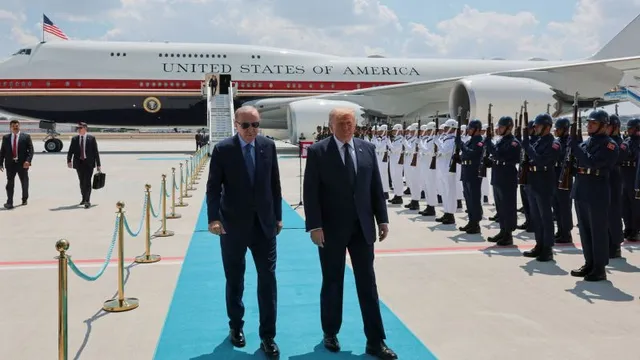
Trump claims US should control Greenland amid NATO summit tensions
politics
controversial
provocative

Trump claims US should control Greenland amid NATO summit tensions

20
(Update: )
president of the United States from 2017 to 2021
autonomous country within the Kingdom of Denmark on world's largest island by the same name
transcontinental country straddling Western Asia and Southeastern Europe
country in Eastern Europe
strait between the Gulf of Oman and the Persian Gulf
  • During a NATO summit in Turkey, President Trump stated that the US should control Greenland, criticizing Denmark's management of the territory.
  • Danish Prime Minister Mette Frederiksen emphasized Denmark's commitment to defend its territory and NATO's collective defense obligations.
  • Trump's remarks reflect ongoing tensions between the US and NATO, raising concerns about the alliance's unity and future military strategies.
Share opinion
2

Story

In Turkey, during a NATO summit, US President Donald Trump expressed his desire for the United States to control Greenland, a Danish autonomous territory. This statement came amidst discussions on various geopolitical issues, including Turkey's potential acquisition of F-35 fighter jets and the ongoing conflict in Ukraine. Trump criticized Denmark's management of Greenland, suggesting that the US would be better suited to oversee the territory, which he claimed does not benefit Denmark. Danish Prime Minister Mette Frederiksen responded by asserting Denmark's readiness to defend its territory, emphasizing NATO's collective defense obligations. The remarks highlighted the strained relationship between Trump and NATO, as he has previously criticized the alliance for not aligning with US interests, particularly regarding military support in conflicts involving Iran and Russia. The summit also featured discussions on strengthening NATO's defense capabilities against Russian aggression, with leaders acknowledging the need for increased military readiness in Europe. Trump's comments on Greenland raised concerns about potential military conflicts and the implications for NATO's unity, as they suggest a willingness to challenge traditional alliances for perceived national interests.