
military conflicts
controversial
impactful

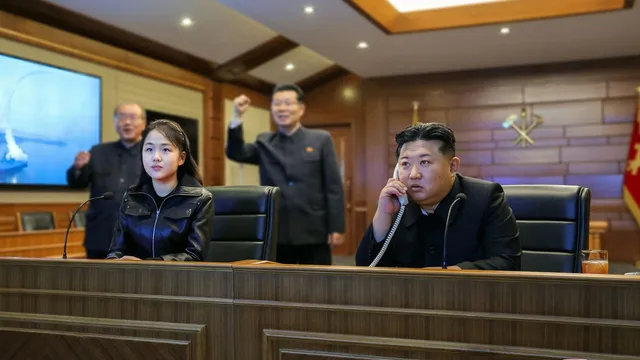
Kim Jong Un conducts cruise missile tests amid US-South Korean military drills

Mar 11, 2026, 6:02 AM40
(Update: Mar 11, 2026, 4:00 PM)
General Secretary of the Workers' Party of Korea and 3rd Supreme leader of North Korea
North Korean state news agency
sovereign state in East Asia

Kim Jong Un conducts cruise missile tests amid US-South Korean military drills

  • North Korea successfully launched strategic cruise missiles from the destroyer Chloe Hyon, overseen by Kim Jong Un and his daughter.
  • The tests occurred amid heightened tensions due to US-South Korean military exercises viewed as provocative by North Korea.
  • This marks a significant demonstration of North Korea's military capabilities and preparedness for strategic action.
Share your opinion
4

Story

North Korea conducted a series of strategic cruise missile tests on March 10, 2026, directing them from the recently commissioned 5,000-ton naval destroyer, Chloe Hyon. The test was reported by the country's state media as being overseen by Kim Jong Un, who was accompanied by his daughter, Kim Ju Ae, who has been appearing alongside him frequently since late 2022. This missile test was characterized by the Korean Central News Agency (KCNA) as part of a response to ongoing military exercises by the United States and South Korea, which North Korea views as provocative. The missiles successfully traveled nearly three hours across the Yellow Sea before striking designated island targets. Kim Jong Un emphasized the importance of these drills in enhancing the military's readiness for strategic action, insisting on the necessity to develop and maintain a reliable nuclear deterrent. The drills portray North Korea’s growing military capabilities in response to perceived threats. The military tests from North Korea are not uncommon, particularly during periods of joint military exercises conducted by close allies, the US and South Korea. These exercises, deemed as rehearsals for invasion by Pyongyang, often provoke retaliatory demonstrations of power, further increasing tensions in the region. Analysts speculate that North Korea's military showcases are intended both to demonstrate its operational capabilities and to solidify Kim Jong Un's political standing, particularly in light of his daughter's prominent role in these events, which some observers interpret as a signal of potential succession plans. The complexity of the geopolitical relationships in this context cannot be understated, as both South Korea and the US characterize their joint maneuvers as defensive. As military tensions continue to escalate, Kim Yo Jong, Kim Jong Un's sister and a prominent official, issued a warning against the drills, calling them an expression of “inveterate repugnancy” towards North Korea. These declarations serve to underline the antagonistic narrative that North Korean leadership uses to unify its domestic audience against external foes while rationalizing military advancements. Simultaneously, the US-South Korea alliance affirms that their joint operations are strictly tailored to enhance readiness in the face of North Korean provocations. The missile tests further add layers to the intricate web of military posturing that characterizes this volatile region, suggesting a looming challenge ahead in diplomatic efforts towards de-escalation. With springtime military drills now commenced, the conflict cycle continues as both sides prepare for a potentially heightened military environment. In this setting, the global community grapples with the implications of North Korea's evolving military strategy, especially in the context of nuclear capabilities and strike readiness. As North Korea affirms its commitment to maintaining a powerful deterrent, international stakeholders are left to contend with the broader ramifications of these developments on regional and global security. Such events ignite pressing discussions about military ethics, diplomatic resolutions, and the future of peace on the Korean Peninsula, as fears of potential conflict loom large in international discourse.

Context

Kim Jong Un's military strategies have been characterized by a combination of aggressive posturing, innovative military technology, and a focus on attaining self-reliance in defense capabilities. Since assuming power in 2011, Kim Jong Un has pursued a trajectory aimed at solidifying North Korea's military stature on the global stage, seeking to deter perceived external threats primarily from the United States and South Korea. This approach has been widely reflected in the country's nuclear weapons program, which Kim regards as essential for national survival and sovereignty. In doing so, he has promoted a narrative that places North Korea as a legitimate nuclear power, leveraging this status to gain diplomatic leverage and security guarantees in negotiations with other nations. His strategy also emphasizes the necessity of maintaining a strong and technologically advanced military force, inspiring ongoing investments in both conventional and unconventional weaponry. Under Kim's leadership, North Korea has significantly advanced its missile technology, achieving milestones in long-range missile testing and developing capabilities for potentially targeting the continental United States. The emphasis on missile development reflects a clear doctrine that prioritizes offensive capabilities, asserting North Korea's strength and readiness to respond to any military provocations. Furthermore, Kim Jong Un has initiated efforts to diversify and modernize North Korea's military frameworks, integrating asymmetric warfare strategies that utilize cyber capabilities to counterbalance the conventional military advantages held by South Korea and the U.S. Through these advances, Kim endeavored to create a formidable deterrence strategy that aligns closely with North Korea's broader political goals. In addition to fostering a robust military, Kim's strategies also underscore the imperative of self-sufficiency in terms of defense research and production. Kim's vision includes cultivating an indigenous military-industrial complex that can sustain North Korea's armed forces without heavy reliance on external sources. This focus on developing homegrown technology is aimed at overcoming sanctions and isolation imposed by the international community. The priority given to self-reliance is evident in the establishment of research and development initiatives, which are aimed at producing advanced weaponry and military hardware domestically. Moreover, Kim has embraced a doctrine of 'byungjin,' advocating for the dual pursuit of economic development alongside military advancement, underscoring his intent to reinforce national strength while enhancing the living conditions within North Korea. In conclusion, Kim Jong Un's military strategies encapsulate a dual approach of aggressive military modernization and self-reliance that seeks to position North Korea as a formidable player on the world stage. By advancing missile capabilities, developing a self-sufficient military framework, and pursuing asymmetric warfare tactics, Kim aims to establish a regime that is resilient against external pressures while achieving political and economic goals. His strategies reflect not only a commitment to national defense but also a calculated effort to navigate the complexities of international diplomacy, demonstrating an evolution in North Korea's military posture that is both assertive and pragmatic.

2026 All rights reserved
