

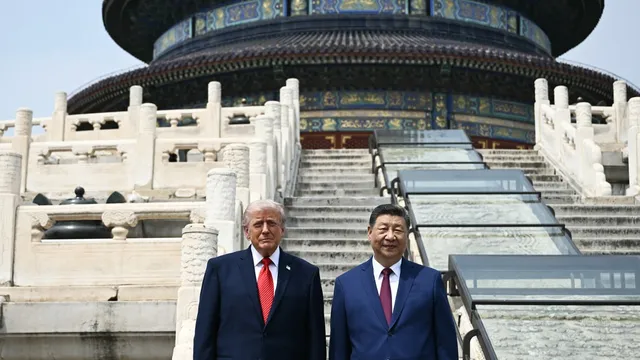
Xi warns Trump about the dangers surrounding Taiwan's status
Xi warns Trump about the dangers surrounding Taiwan's status
- Xi Jinping emphasized Taiwan as a crucial aspect of U.S.-China relations during their summit.
- Donald Trump remained silent on the Taiwan issue despite media inquiries.
- The summit highlights the need for careful management of U.S.-China relations amid rising tensions.
Story
In Beijing, the leaders of the United States and China, Donald Trump and Xi Jinping, met for a critical two-day summit where they discussed important bilateral issues. The meetings, which lasted for over two hours, featured discussions on contentious topics including trade, the conflict with Iran, and especially Taiwan, which Xi emphasized as a core issue in their relationship. On this occasion, Trump remained largely silent on the subject of Taiwan despite inquiries from the press about whether it was addressed during their talks. Xi's assertive stance on Taiwan indicates the heightened tensions surrounding the island, which Beijing claims as its territory. Many observers noted that while Trump and Xi expressed mutual respect publicly, the underlying issues at stake have the potential to destabilize U.S.-China relations. Trump, during his visit, highlighted the importance of a strong relationship with China, mentioning his desire to have reciprocal trade discussions, showing he intended to address trade imbalances and open up China to American businesses. However, Xi's warning that failing to respect China's stance on Taiwan could lead to conflict was a clear signal of the gravity of this situation. Furthermore, Taiwan's government reacted with cautious optimism, indicating that they believe U.S. policy towards Taiwan would remain unchanged despite the summit. Taiwanese officials also expressed that they were preparing for potential surprises, showcasing their readiness for a variety of outcomes in the wake of the meeting. This reflects the delicate balance that the region maintains amidst the growing tensions. The broader implications of this summit go beyond just trade and Taiwan; the challenges posed by technology, artificial intelligence, and geopolitical rivalries underscore the complexity of U.S.-China relations. Xi and Trump face pressures from both domestic and international fronts that require careful navigation to avoid exacerbating tensions. As they sought common ground, both leaders are aware that the world is watching their interaction closely, given its impact on global political dynamics. Their ability to manage these discussions could well shape the future trajectory of U.S.-China relations.
Context
The issue of Taiwan remains a focal point in the complex relationship between the United States and China, fundamentally influencing diplomatic, economic, and military interactions. As Taiwan operates as a self-governing entity with its own political system and democratic elections, its status is a sensitive subject for China, which views it as a breakaway province that should be reunified with the mainland. This perception affects China's foreign policy and is a significant element of its national identity. The United States, while officially adhering to a One China policy, engages in various forms of support for Taiwan, which complicates its relationship with China. This situation is further exacerbated by the strategic importance of Taiwan in regional security dynamics, especially given its position in the First Island Chain, which is critical for both U.S. and Chinese military strategies in the Asia-Pacific region. In recent years, the U.S. has enhanced its ties with Taiwan through arms sales and diplomatic exchanges, which Beijing perceives as provocative. Washington's commitment to Taiwan is underscored by the Taiwan Relations Act, which obligates the U.S. to provide Taiwan with the means to defend itself against any aggression. This has led to increased military strains, with China conducting more military drills near Taiwan during periods of heightened tension. As a result, the Taiwan issue not only influences bilateral relations but also shapes perceptions in the broader international community, with countries watching how the U.S.-China rivalry plays out in terms of Taiwan's security. The implications of the Taiwan issue also extend to economic dimensions, as Taiwan is a vital player in global supply chains, particularly in the semiconductor industry. Taiwan Semiconductor Manufacturing Company (TSMC) is crucial for both U.S. and Chinese technology sectors, making Taiwan a linchpin in the ongoing technology competition between the two superpowers. Any aggressive moves by China towards Taiwan could thus disrupt supply chains and catalyze a broader economic decoupling, with significant consequences globally. Moreover, both nations leverage economic relations to bolster their position regarding Taiwan, with the U.S. seeking to strengthen ties with allies in the region while promoting Taiwan's participation in international organizations, enhancing its international standing. Ultimately, the Taiwan issue is a litmus test for U.S.-China relations, as it encapsulates the balance of power in East Asia while illustrating the competing narratives around national sovereignty and self-determination. The stakes are high, with potential ramifications that extend beyond bilateral relations to global security and economic stability. Policymakers must acknowledge the multidimensional aspects of this relationship, considering military, economic, and diplomatic strategies carefully to prevent escalation while supporting regional stability and Taiwan's democratic aspirations. The challenge lies in navigating these complex dynamics amidst rising nationalism and the potential for conflict.


