
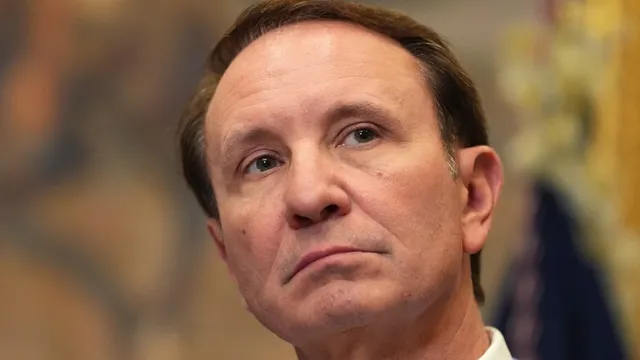
Trump appoints Landry as special envoy to Greenland amid tensions
- In August 2025, President Trump appointed Louisiana Governor Jeff Landry as the special envoy to Greenland, highlighting its strategic significance.
- This announcement has caused tensions with Denmark and Greenland, fueled by concerns over sovereignty and American expansionist interests.
- The appointment raises critical questions about the future of Greenland, national security, and international respect for territorial integrity.
Story
In late August 2025, U.S. President Donald Trump announced the appointment of Louisiana Governor Jeff Landry as the new special envoy to Greenland. This decision has reignited discussions surrounding American interests in the autonomous Danish territory, which is known for its mineral resources and strategic location in the Arctic. Trump's continued overtures towards Greenland, highlighted by his previous statements advocating for U.S. jurisdiction over the territory, have raised concerns in Denmark and Greenland about sovereignty and territorial integrity. The leaders of both regions, including Danish Prime Minister Mette Frederiksen, promptly rejected the notion of U.S. control over Greenland, advocating respect for international borders and sovereignty. The U.S. appointment of a special envoy signals a sustained interest in Greenland, which sits along crucial shipping routes and is seen as strategically important for U.S. national security. Governor Landry, who took office in January 2024, has publicly supported Trump's controversial objectives regarding Greenland. In announcing his new role, Landry expressed his appreciation for the opportunity to serve in a volunteer capacity aimed at making Greenland a part of the United States, emphasizing the potential benefits for both parties. His remarks have led to further apprehensions among Greenlandic and Danish officials regarding potential encroachments on their autonomy. The Danish foreign minister Lars Løkke Rasmussen reaffirmed his government's position, insisting that the United States must respect the Kingdom of Denmark's territorial integrity. Amid growing tensions, the appointment has sparked critiques from Greenland's political leaders, who have asserted that most Greenlanders wish to maintain their independence and develop their political status over time, rather than merging with the United States. They have voiced strong opposition to the idea of annexation, stressing that their future should be determined by the Greenlandic people. In light of these developments, the U.S. efforts to deepen ties with Greenland amid concerns over its security and economic viability could be interpreted as acts of diplomacy. However, Trump's ambitions signal a persistent challenge to the delicate balance of relationships in the Arctic and bring to light the complex interplay between national security strategies and international law regarding territorial integrity and self-determination. As this situation evolves, the implications for U.S.-Danish relations and Greenland's future remain uncertain, with continued dialogue likely needed to navigate the challenges ahead.
Context
Greenland holds a crucial geopolitical significance, primarily due to its strategic location between North America and Europe. Its geographical position allows for critical maritime routes and air travel corridors that connect the Arctic, the Atlantic, and the Pacific Oceans. The Arctic region is increasingly becoming a focal point for global powers due to climate change, which has led to melting ice and opening up new shipping routes as well as access to untapped natural resources. This scenario has prompted countries, particularly the United States, Russia, and China, to enhance their interest and presence in the region, seeing it as essential for national security and economic exploitation. The military aspect of Greenland's significance cannot be overlooked. The U.S. military bases, particularly Thule Air Base, serve as a pivotal point for operations in the Arctic, providing crucial support for surveillance and missile defense systems aimed at counterbalancing adversarial threats. Given the increasing tensions in global geopolitics, especially between the US and Russia, Greenland's role as a staging ground for military operations and intelligence gathering has become more pronounced. The presence of these military installations underlines the island's importance not only to the United States but also to NATO allies who rely on access to Arctic strategies to guarantee security in the face of shifting power dynamics. Economically, Greenland's vast natural resources, including rare minerals, oil, and gas, place it at the center of geopolitical negotiations and considerations. The potential for resource extraction in a warming Arctic creates an economic boondoggle, inviting investment from foreign nations and corporations eager to gain an upper hand in the shifting energy landscape. Greenland's resources have attracted attention from both established powers and emerging economies. China's interest, particularly in rare earth minerals, has led the country to seek partnerships and investments. However, this has raised concerns about sovereignty, environmental implications, and the potential over-reliance on foreign powers for economic development. Additionally, Greenland's political ties with Denmark serve as a unique aspect of its geopolitical significance. As an autonomous territory, Greenland's relationship with Denmark interlinks with larger dynamics at play, such as climate change policies, Arctic governance, and international law. Its status allows it to participate in certain international organizations, yet it remains tethered to Danish foreign policy, complicating its ability to independently navigate geopolitical waters. As the Arctic continues to open up and international interest surges, Greenland's geopolitical significance is likely to grow, making it an essential focus for future political, economic, and environmental discussions.
