

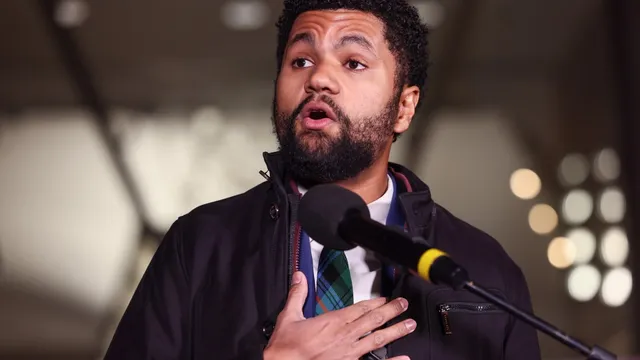
Congressman Maxwell Frost assaulted by man at Sundance Film Festival
Congressman Maxwell Frost assaulted by man at Sundance Film Festival
- Rep. Maxwell Frost was assaulted by a man at a private Sundance Film Festival party.
- The assailant, identified as Christian Young, made racially charged threats before the attack.
- The incident highlights concerns over political violence and safety at public events.
Story
On January 21, 2026, in the United States, Congressman Maxwell Frost was assaulted during a private party at the Sundance Film Festival in Park City, Utah. The incident occurred when a man named Christian Young, who had crashed the event, allegedly punched Frost in the face after making racially charged remarks. Young had previously been denied entry due to not having an invitation but managed to enter unlawfully, where he confronted Frost and made threats suggesting that President Donald Trump would deport him. The man’s aggressive behavior escalated from the bathroom where he exhibited racist comments, culminating in the physical assault. Frost later reported that during the confrontation, Young not only punched him but also screamed offensive racial remarks as he fled the scene. Fortunately, venue security and the Park City Police Department responded quickly, detaining Young shortly after the assault occurred. Young was later arrested and faced multiple charges, including aggravated burglary and simple assault. His actions highlighted the ongoing issues of racial hostility and political violence that have increasingly become pressing societal concerns in the United States. House Democratic Leader Hakeem Jeffries expressed horror over the attack, condemning it as a manifestation of the political violence gripping the nation. He affirmed that the entire House Democratic Caucus stood in solidarity with Frost, emphasizing that there is no place for hate or violence in the country. This incident has spurred discussions about the safety of public figures and minorities in politically charged environments, especially given the rising occurrences of racially motivated attacks across the nation. As this situation unfolds, the question remains regarding the legal ramifications for Young and the broader implications of such assaults on public discourse and political engagement. Events like these are indicative of the troubling trends where public events are marred by violence and intimidation, raising alarms about the societal fabric that underpins civil discourse within America. The investigation continues to explore the motivations behind this attack and whether it signifies a larger pattern of aggression towards individuals in political positions, particularly those of color.
Context
The history of political violence in the United States is a complex and multifaceted subject that spans centuries, reflecting various societal tensions and conflicts. Political violence has manifested in numerous forms, including riots, assassinations, terrorism, and state-sponsored violence. From the American Revolution through the Civil Rights Movement and into contemporary times, politically motivated violence has often emerged in response to perceived injustices, systemic inequality, and political disenfranchisement. The roots of such violence can be traced back to the early days of the Republic, where tensions between federal authority and state interests ignited conflicts such as the Whiskey Rebellion and Shays' Rebellion, highlighting the struggle for power and representation in a nascent democracy. These instances laid the groundwork for ongoing conflicts surrounding political authority and personal liberty, revealing a pattern where citizen unrest often peaked amidst broader political or economic crises. As the nation evolved, so did the expressions of political violence. The Civil War marked a significant escalation of political violence, where ideological divisions resulted in not just battlefield confrontations but also violent uprisings such as the New York City Draft Riots of 1863, which underscored the volatility of public sentiment during wartime. Post-war Reconstruction also witnessed acts of violence aimed at suppressing the political rights of freed African Americans, exemplified by the rise of groups like the Ku Klux Klan. These organizations employed terror tactics to undermine civil rights efforts, revealing the interaction between systemic racism and political violence. This period was critical in shaping the relationship between race, politics, and violence, a dynamic that continues to resonate in contemporary political discourse. The 20th century saw the emergence of various forms of political violence tied to civil rights movements, labor struggles, and anti-war protests. For instance, the civil rights movement faced significant violent opposition from segregationists and law enforcement, exemplified by events such as the Birmingham campaign and the Selma to Montgomery marches. These moments of confrontation played a pivotal role in highlighting the deep-seated racial and economic injustices in America and ultimately pushed for legislative changes, including the Voting Rights Act of 1965. Similarly, the anti-Vietnam War protests often met with violent suppression by authorities, illustrating the broader tensions between governmental authority and grassroots movements advocating for social change. Political violence during this era reflected a society grappling with rapid change and the contestation of traditional power structures. In more recent years, political violence in the U.S. has taken on new forms, shaped by factors such as globalization, technological advancements, and political polarization. Events like the Oklahoma City bombing in 1995, the September 11 attacks in 2001, and the January 6, 2021, Capitol riots have drawn attention to the evolving nature of political violence, where ideological extremism and online radicalization have played significant roles. Such incidents have prompted discussions around domestic terrorism, the responsivity of law enforcement, and the challenges of safeguarding democratic institutions. Examining the history of political violence in the U.S. reveals not only the persistent challenges of addressing societal divisions but also the essential examination of how those in power respond to dissent and challenge, shaping the continuous evolution of American democracy.


