

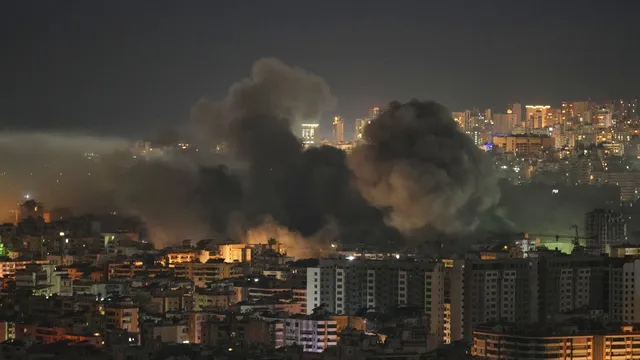
Iran retaliates with new attacks amid escalating Israeli and U.S. strikes
Iran retaliates with new attacks amid escalating Israeli and U.S. strikes
- Israeli airstrikes have targeted Iran and Lebanon, with U.S. forces striking an Iranian drone carrier at sea.
- Iran retaliated with attacks against neighboring countries that host U.S. forces, escalating regional tensions.
- The current situation reflects a week of sustained military conflict, with significant implications for Middle Eastern stability.
Story
On March 6, 2026, Iranian forces initiated fresh retaliatory actions against neighboring nations that host U.S. military personnel. This escalation comes as Israeli airstrikes have targeted key locations in both Iran and Lebanon, and U.S. forces have reportedly struck an Iranian drone carrier at sea. The intensification of military activity has persisted for a week, affecting several countries across the Middle East. Despite the absence of immediate reports of casualties, the Israeli military claims that the sustained aerial engagement has effectively neutralized a substantial portion of Iran's air defense systems and missile launch capabilities. U.S. officials, including Defense Secretary Pete Hegseth, warned that attacks against Iranian assets are expected to escalate significantly in the coming days. Iran's response to the ongoing strikes has raised concerns about wider conflict, particularly as the Iranian leadership council convened to discuss the future election of their supreme leader amidst the turmoil. The U.S. and Israeli actions reflect a broader agenda to undermine Iran's military capabilities and regional influence, especially pertinent as Iranian officials have issued severe warnings about the potential devastation of military and economic infrastructure throughout the Middle East. Financial markets have reacted nervously to the conflict's unfolding, indicating the geopolitical implications of this military escalation. Amidst this backdrop, Saudi Arabia reported successful interceptions of drones and cruise missiles in its eastern regions, highlighting the regional spillover effects of the ongoing conflict. The United Arab Emirates has also been proactive, sending out mass notifications to its residents in Dubai regarding social media usage, cautioning against sharing sensitive information that might compromise national security. This is indicative of heightened tensions and the precarious nature of stability in the region as military actions ramp up. The complexity of the situation is further exacerbated by the potential for asymmetric warfare as Iran looks to retaliate and demonstrate its military prowess despite significant losses. The developments underline the intricate interplay between military operations and regional politics, as state and non-state actors navigate the volatile landscape of Middle Eastern geopolitics where alliances and animosities can shift rapidly.
Context
The history of Iranian-U.S. military tensions is a complex narrative that spans several decades, characterized by a series of confrontations and geopolitical maneuvering. The origins of these tensions can be traced back to the 1953 CIA-backed coup that overthrew Iran's democratically elected Prime Minister, Mohammad Mossadegh. This event set the stage for decades of mistrust, especially following the 1979 Iranian Revolution, which established an anti-U.S. Islamic Republic led by Ayatollah Khomeini. The seizure of the U.S. Embassy in Tehran and the subsequent hostage crisis illustrated the deep-seated animosity, resulting in a complete severance of diplomatic ties between the two nations and the imposition of crippling economic sanctions on Iran by the U.S. government. The Iraq-Iran War, which lasted from 1980 to 1988, further intensified U.S.-Iranian hostilities. The United States supported Iraq under Saddam Hussein in an effort to contain the spread of Iran's influence, showcasing a pattern of American involvement in Middle Eastern conflicts that would continue into the future. Following the September 11, 2001, attacks, the narrative shifted as Iran was initially viewed as a potential ally in stabilizing the region. However, the U.S. invasion of Iraq in 2003, which resulted in the destabilization of the Iraqi government and the rise of Iranian influence in Iraq, reoriented the relationship back towards hostility. In the years following the Iraq War, military tensions between Iran and the U.S. saw fluctuations, particularly highlighted by incidents in the Persian Gulf, where U.S. naval forces intercepted Iranian vessels and faced harassment from Iranian military assets. The emergence of nuclear ambitions in Iran further complicated the situation. The U.S. and its allies raised alarms over Iran's nuclear program, leading to the formulation of the Joint Comprehensive Plan of Action (JCPOA) in 2015, which aimed to curtail Iran's nuclear capabilities in exchange for lifting economic sanctions. While the agreement marked a significant diplomatic effort, it was short-lived; the U.S. withdrawal from the JCPOA in 2018 under President Donald Trump drastically escalated tensions, prompting Iran to resume parts of its nuclear program and engage in retaliatory actions against U.S. interests in the region. The military tensions have continued to evolve into 2026, with various incidents such as drone strikes, cyber warfare, and proxy conflicts throughout the Middle East highlighting a fraught and precarious relationship. Diplomatic efforts to resolve the standoff have been sporadic, overshadowed by mutual accusations of aggression and terrorism. As the Biden administration attempts to navigate a path towards renewed negotiations, the history of mistrust and conflict serves as a significant backdrop, raising questions about the prospects for peace and stability in a region historically marked by U.S.-Iran tensions. The future of Iranian-U.S. relations will likely depend on the ability of both nations to address the underlying grievances and acknowledge their shared interests, balancing military posturing with diplomatic dialogue.


