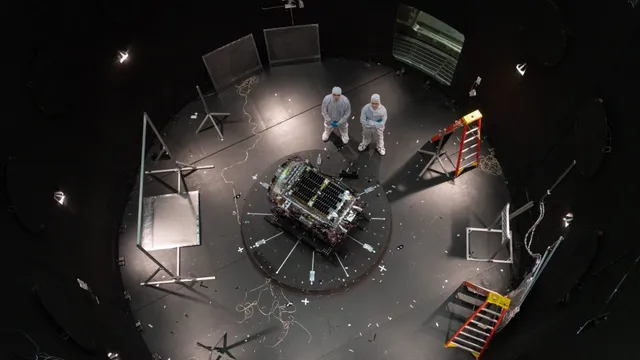
In the United States, NASA is facing a critical situation with the Swift gamma-ray observatory, which has been operational since its launch in 2004. Due to recent intense solar activity, Swift has been descending rapidly and is at risk of reentering the Earth's atmosphere, which would result in the loss of this valuable telescope. Observations from Swift ceased in February, and it is projected to reach a point of no return by October. To prevent this, Katalyst Space, led by CEO Ghonhee Lee, is developing a next-generation robotic spacecraft named Link, which is designed to perform repairs and maintenance on satellites in orbit.
Link is expected to take about a month to rendezvous with Swift and then an additional couple of months to elevate its orbit from 224 miles to the desired 373 miles. The spacecraft is equipped with three arms that have grippers resembling Lego mini-figure hands, allowing it to grasp and manipulate objects in space. This mission represents a significant advancement in American space robotics, as it is the first of its kind to attempt such a rescue operation. If successful, Swift could resume its operations by September, providing critical data and observations alongside other telescopes like the Webb Space Telescope and the soon-to-launch Roman Space Telescope.
NASA's astrophysics director, Shawn Domagal-Goldman, emphasized the importance of Swift, stating that losing it would mean a significant setback for the agency, especially since there are no current plans or budget to build a replacement. The mission to save Swift is not just about preserving a single telescope; it is seen as a stepping stone for Katalyst Space to establish a new business model for satellite repair and maintenance in space. Lee envisions a future where hundreds of robots could be deployed to not only fix satellites but also refuel them and construct various platforms in orbit.
The urgency of the situation is underscored by the fact that Swift is considered NASA's first responder for gamma-ray bursts and other cosmic phenomena. The potential loss of this observatory would hinder ongoing and future astronomical research. As Katalyst Space prepares for this ambitious mission, the success of Link could pave the way for a new era of robotic assistance in space, ensuring that valuable scientific instruments remain operational and continue to contribute to our understanding of the universe.